Showing posts with label Mystic. Show all posts

Friday, October 16, 2020

My American Dream: Finding Its Way

Brooklyn vs. Rochester


By Norma Jaeger Hopcraft


Someone I knew from New York City wrote to me yesterday with what seemed to be a snickering attitude.  

“What, Rochester?” he wrote, implying “Where the heck is that?” I can’t condemn him, I’ve had the same attitude, and still do, just a little.

I’ve lived near New York City, and the immense range of activity it offers, most of my life. Then, starting six years ago, I began a series of moves to places with a ton of cach
é: Mystic, Connecticut, then Paris and Barcelona. Then I fulfilled a life-long dream and moved into NYC itself: the Upper East Side of Manhattan (for two months), and Brooklyn (for four years). Brooklyn in its own right is such a storied city. I saw baseball caps with “Brooklyn” on them in France and Spain.

How Can I Search for the American Dream Here?


Where the heck, on the other hand, is Rochester? The downtown has two tall buildings and is dead at night. There is a more lively neighborhood of cafes and restaurants known as the Park Avenue neighborhood, and I’m searching for an apartment in it. But even that neighborhood doesn’t seem to have much “there” there, not after the electromagnetic force of Brooklyn.

I must suspend judgment of Rochester as a city, as a venue for the arts, as a place that fosters my creative inspiration, until the pandemic eases. It won’t feel like home until ballroom dancing resumes, and the theater group I want to be involved in (as a mere set painter, not as the superstar that I, in reality, am) springs into action again, and the Wild About Writing circle can meet in person. And in Rochester, I will be able to afford to hear live classical music regularly at the Eastman School of Music! Carnegie Hall was beyond my reach. 

I'm a snob

I do miss Brooklyn. Not so much living there, because life was tough, overwhelmed by tons of stressed-out strangers in a brick, asphalt, chain-link, and razor-wire jungle. But I miss being FROM there. I wrote on my Amazon author profile that I’m a writer who lived in Paris, Barcelona, and now Brooklyn. Those place-names have cach
é. I’m a sucker for caché. I’m a location snob, I admit it. 

“Rochester, New York” has ZERO cache. But maybe it should have a little. It is a unique epicenter of social justice. Harriet Tubman lived near here. Frederick Douglass lived here, wrote here, and delivered his famous speech here, "What to the Slave Is the Fourth of July?", delivered on July 5, 1852, addressing the Rochester Ladies' Anti-Slavery Society.  Women’s rights were championed by women in this area, notably Susan B. Anthony, who lived and wrote in Rochester. Another example of social compassion: Rochester Institute of Technology has a nationally recognized center for deaf students.
 
Brooklyn's advantages

Brooklyn had advantages. I could choose all kinds of organic fruits and vegetables at the Flatbush Food Coop, a 10-minute walk. I can’t find that variety here, and you have to drive to the grocery store. I could walk to three Indian restaurants, three Mexican, two burger joints. I could have lavender lattés at Café Madeline. I don’t know of a café in Rochester that has even dreamed of serving them. Prospect Park, with world-class design, was a 10-minute walk. 

In Brooklyn I lived near three international airports that could take me on direct flights to friends in France or family in small cities like Asheville, NC, Providence, RI, or Rochester, NY. I could easily grab a bus to visit family in Bethlehem, PA. I could easily take the train to Fire Island or to the Jersey Shore. Now that I’m in Rochester, I’m closer to one part of my family but have bigger hurdles to overcome to get to the rest. And getting to the Atlantic Ocean is a huge undertaking.

In Brooklyn, I felt I was in the center of the world. On Ocean Avenue, during my quarter-mile walk to do my laundry, I heard voices from Pakistan, Liberia, Panama, Jamaica, Barbados, Senegal, Kazakhstan. At any given moment on Church Avenue, I could make videos for my little grandson of trucks of every shape and size and function, and long, articulated city buses. 

Rochester contrasts

Here at this house in Rochester, it’s quiet. Once a week a garbage truck goes by. But I can do my laundry downstairs instead of trundling it a quarter of a mile each way.

There were other downsides to Brooklyn. In spite of my best efforts to build friendships and stay connected, I felt acutely alone. The streets felt dangerous. People were indifferent (of course they were, we were all strangers to each other). It broke my heart to see groups of young men hanging out, passing a joint, with tons of pent up energy and talent but lacking the education—and faced with racism in hiring practices—that prevented them from getting into a decent job, unleashing that talent, making a living wage, and making a contribution.  They could have run a company—or a country—but were trapped.
 
I felt a keen desperation in the atmosphere on the streets. I lived in a gentrifying neighborhood. As rents leapt upward, people were more and more worried about making rent that month. I could feel the anxiety in the air. So many people lived hand to mouth with no hope of a better life – and angry about that fact, and about the racism that locked them into this predicament, locked them out of the American Dream.

And then there was the dog poop. Many people did clean up after their dogs, but enough people didn’t that there was a hazard when out walking or pulling a cart full of laundry. I had to keep my eyes on the sidewalk. Which might have been just as well—looking at groups of young men passing a joint might get me in trouble, so I had to keep my eyes down anyway. Which I didn’t like. As an artist, I love to look around and notice things. I want to look at people and imagine their lives. In Brooklyn, that wasn’t wise to do because you might notice a crime. I really hated keeping my head down.

Starting over in Rochester

Here in this suburb of Rochester, I can smile and give a little wave to the people I pass when I’m out walking, and get one in return. We’re privileged to be living in a lovely neighborhood. I’ve nicknamed it “The Arboretum” because of the stately huge shade trees, and blooming trees, and shrubs. During the summer there were eight-foot-tall hydrangeas in some gardens, burgeoning with blossoms, exuding charm. 

So I’ll start life anew in Rochester.  I have to overcome my location snobbery and embrace the advantages this situation offers. One of them might be a sense of dislocation. Exile has proven to be good for my creativity in the past, especially in Paris and Barcelona, and it’s helping me again, I believe. 

I have discovered, to my joy, that I really love swimming in Lake Ontario. I thought the lake would never suffice, not after the joy of being in the Atlantic surf at Fire Island or the Jersey Shore. But the lake has its advantages—most days, it’s quiet enough for me to really swim without having to fear being inundated by breaking waves, as I would in the Atlantic. 

Also, in spite of the pandemic, I’ve made a new, in-person friend! She has put me in touch with working artists in the area, including a local set designer. I’m working on a novel about a set designer, so that interview will be very interesting! 

Brooklyn is a great place. I miss it, and I’m so relieved to be out of it.

How about you? Do you have mixed feelings about a place you used to live? Or that you live in now? Comment below! 


Saturday, July 7, 2018

In Search of the American Dream -- an American Writer Wants to Go to Paris to Write


How a Traveling Writer Ended Up in Paris -- Part II

by Norma Jaeger Hopcraft


I was living with my frail, tiny, 84-year-old mother, cooking for her, trying to tempt her to eat by making foods just the way she liked. After breakfast, which she picked at, her aide would arrive, and I would be free for a few hours.
So I explored coastal Connecticut. My mother lived in Mystic, which in itself is mystical. Route 1 went through Mystic and over its iconic drawbridge. Strung along Route 1 was a series of towns that were historic, interesting, beautiful: Stonington, Niantic, Madison, Old Lyme.

The Traveling Writer In Search of the American Dream
The Charles W. Morgan was refurbished in Mystic, then sailed--for the first time in many decades--to New London for tours by the public.

The Traveling Writer In Search of the American Dream
Arriving by ferry into New London one evening, I caught the Charles W. Morgan silhouetted against the sunset.

The Traveling Writer In Search of the American Dream
The lighthouse just outside New London.

One of the lovely historic homes in Stonington, CT.


More pics of coastal Connecticut here and here.

In Search of the American Dream Takes a Twist


One day, I took Route 1 to New London. It has lots of history as a whaling and fishing town. It's suffered hard times for many decades, but it’s now gaining ground slowly with some recovery downtown.
I wandered among the historic commercial architecture downtown and suddenly spied something that I’d never noticed before: an independent bookstore!
I dashed in. It was a cold January day, with freezing blasts of bone-chill air off the Long Island Sound. The bookstore’s huge picture windows were steamed up with the temperature difference between indoors and out.
I was delighted with what I found inside: a grand piano covered with an eclectic collection of antiques and memorabilia. A café with chairs and tables along the huge storefront windows. New Londoners sat talking, discussing their latest projects. 
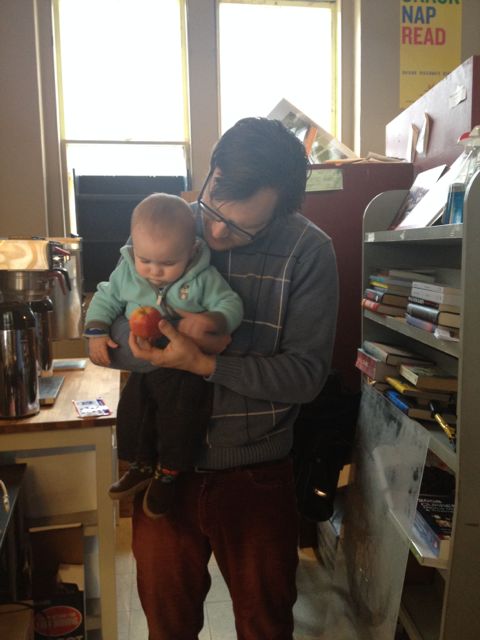
I hunted for the owner. He was holding his nine-month old son on one hip and writing inventory with one hand.

“I love indie bookstores, and I support them by writing about them on my blog,” I said. “Can I take some pictures?”
“Sure,” he said. So I poked around with my camera.

"Buy a Book! You'll still be cold...but at least you will have a book!"
I stepped out of the bookstore later, into the cold air, with a book that changed my life.

The owner with his baby son.

Where the family hung out during long days in the shop.

I love the old tin ceilings.

The piano: piled with books!

The cafe, where New Londoners discussed their latest projects.


The owner made coffee, bobbled the baby, and sold books.

Creative collaboration?


As I left, the owner snuggled his baby.


The bookstore was quiet and lovely. I thought I really should support the bookstore with more than just a post on my blog. Especially one owned by a family. But I had to be really careful with money, so I poo-pooed that idea.
I snapped a few more pictures. And I heard a still small voice say, “Norma, put your money where your mouth is. Buy a book.”
That’s Higher Power, my heart said.
So I went back to the owner and asked where the writing section was. He directed me around the corner of a bookshelf, and there I saw a little brown book. A Writer’s Paris, by Eric Maisel.
“Thanks a bunch, HP, I’ll never get to Paris. You’re just making me jealous,” I thought. But I took the book off the shelf, opened it, and read a random paragraph.
“If you’re an American writer, you need to go to Paris to write. Go for 1 month, or 3 months. Better yet, go for a year. Paris is one of the more affordable great cities of the world. You can do it! Just go!”
Well, I thought to myself. Am I qualified? Am I a writer? I didn’t have an exceptional track record of being published, not by any means. But I’d persevered for years in a writing apprenticeship. I'd graduated from New York University's creative writing program magna cum laude. It has all been a ton of work. But I'd persevered. For years. Yes, I decided, I certainly could count myself as a writer.
But could I actually go to Paris? And live there?
The idea exploded in my mind. I bought the book.
I would not go as long as my mother needed me, which I hoped would be years.
But when I got home, I Googled “French visa” and was led to the site of the French Consulate in New York City, which serves New York, New Jersey and Connecticut. I studied the documents I’d need, which included a letter from a French sponsor.
I cared for my mother, and while she was resting began to network with people for contacts in France.
I emailed a French pastor in Paris that one of my friends in New Jersey knew of. He told me that he would be willing to write the sponsorship letter, but that he rented an apartment, would be moving soon, and the French government wouldn’t be impressed with him as my sponsor.
“You need someone who owns property in France,” he said.
I tucked that thought away and continued to care for my mother. I wanted her to thrive and enjoy life for as long as possible. She had cared for me as a helpless infant and small child. She had borne with me during the years when I was a rebellious, moody teenager full of scorn for her stupid, old-fashioned, protective ways. I owed her my very life, and I would make hers as enjoyable, comfortable, and fulfilling as I could.
But overnight she declined so steeply that we asked hospice to come in. A few days later she was in bed around the clock. A week after that she was on morphine. She died a few days later.
My siblings, my whole family, were in deep mourning over the rather sudden loss of this extremely adorable and wise little person. The funeral, the burial, all felt distant, unreal, impossible.
While still grieving (and I still miss her daily), I began to help my siblings by organizing and cleaning my mother’s condo to get it ready for sale. In between emptying closets, I returned to my research on being an American writer in Paris.
It seemed like something that would be too good to come true for me. Life had been very tough for a long time. After a heart-wrenching divorce, I’d raised two children alone. I’d worked to support them by holding down jobs in tough corporations in New York City. I’d lost jobs to corporate bullies and to mergers. I’d been hunting for a job for three years already in the non-profit realm without finding one, with all the rejection that entailed. Was something as glorious as Paris possible for me?
I talked to my pastor. “Should I go to Marfa, Texas, or Taos, New Mexico, instead?”
“Emily Dickinson had her Paris—her bedroom,” he answered. “Thoreau had Walden Pond. You just need to find your Paris.”
I loved that he was giving me support, and a sense of freedom, to decide.
I decided I’d worked so damn hard for so damn long that I deserved my heart’s desire. I decided Paris was my Paris.
My kids were adults and on their own. My mother didn’t need me anymore, God bless her. No job required me to show up every day. I had the rental income from my house and a small pension. If I was extremely careful with money—not buying coffee in cafes more than once a month—I might make it in Paris for a year.
I just needed a sponsor.
The story continues…come back next week! Or sign up to follow--in the righthand column.

Thursday, August 6, 2015

An Sculpture's Dream: A Studio in an Old Mill

American Dream for an Artist: His or Her Own Studio

By Norma Jaeger Hopcraft


In Stonington, CT, there is a huge old velvet mill, one of many textile mills in New England that closed when the cheap labor of the South put them out of business. 


This historic commercial architecture somehow survived and is now used to host a Saturday market that draws thousands. It also is a rabbit-warren of studios: weaving, pottery, sculpture, photography, painting. This picture is 1/64th of the space available here. There are several indie coffee shops inside!


Here is a sculpture by this artist -- name unknown -- that caught my eye in one of the many labyrinthine hallways of the mill.


The sculpture is made up of hundreds of these little people-forms.

Say, if you like my blog, would you sign up to follow it? And RT the tweet that brought you here? Tnx!!


Here's a bunch of people admiring the little people! Next week: More studios! How about you? Do you crave a space in which to be artistic? Comment below!


Friday, April 3, 2015

American Dreams in Mystic, CT

American dreams of a boat

By Norma Jaeger Hopcraft

Say, if you like this blog, sign up to follow!

You could fulfill your dreams for a boat by buying it used at Mystic Marine Consignment (see last week's post, too). 


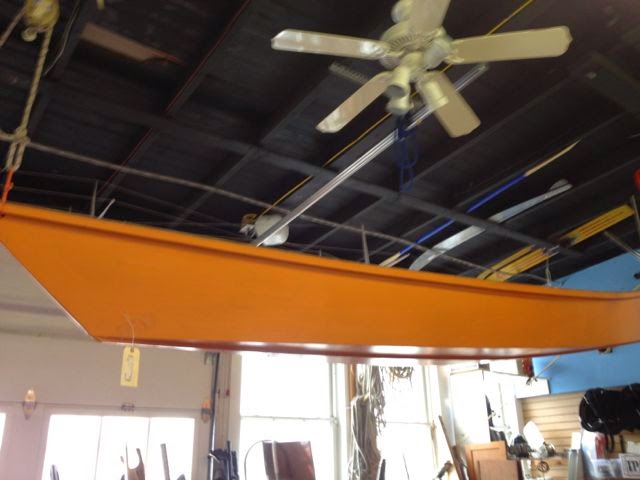
Here's a sleek hull. 


Here's life preservers for you and the crew.

All the gear you could ever need, used and inexpensive.


All kinds of block and tackle for hoisting a sail.


And in the bow, this cannon to get other boats out of your way! 

How about you, thinking of buying a boat? Already enjoying one? Comment below! If you like this blog, recommend it to your friends!


Thursday, March 26, 2015

American Dream: A Used Nuclear Submarine, Perchance?

American Dream: Think big, bigger, biggest!

By Norma Jaeger Hopcraft

Say, sign up to follow my blog and get the latest version in your inbox! 

Or follow me on Twitter: @nhop1234.

You will not believe all the nautical stuff you can buy used. Practically a nuclear submarine! Visit Marine Consigment of Mystic, 15 Holmes Street.


A wet suit, or a cooler.

Anchors (they look like sailboats themselves, jib and mainsail).

Would you like an upgrade from your car's factory steering wheel?

Not a nuclear submarine, but getting there....

Lighthouses for your collection. Next week, more surprising stuff. How about you? Do you shop consignment? My winter coat is second-hand. Fits perfectly, sleeves just the right length. Keeps me warm. $25. 

Wednesday, February 11, 2015

American Dream: Owning a New England Farm

Connecticut Yankees Say "Work on Your Dream Now, Before It's Too Late"

By Norma Jaeger Hopcraft

I have a friend in Stonington, CT, who has an ancient cemetery on her property, way back in the woods. On a gray winter's day, she took us there.


These are the stones of a husband and wife.

Hardly readable anymore because of the lichens.

This is it, the whole shebang.

A classic Connecticut rock wall on the former farmland. Did you know the state flower of Connecticut is the rock?

Lichens on the living trees, too.


The farmers left openings in the rock walls to drive a team through.

The fact that this wall is still standing after more than 100 years is a testament to the farmer's skill in building it.

My friend's sons sit on this overstuffed chair and wait for deer to walk by. It's not a happy ending for the deer. Her sons use almost every part of it for food, however.


Tuesday, January 27, 2015

American Dreams of Stardom as Musicians

The Telegraph, New London, CT

By Norma Jaeger Hopcraft

The Telegraph caters to the fertile counterculture in New London. There are lots of young people toting guitars in this town. Two big stores across the street from each other sell musical instruments, one of them exclusively guitars.


To be successful as a musician, listen to the past.

The assortment is huge.

There's another shop like this in Mystic, selling only old vinyl rock 'n roll.

You can also buy books at the Telegraph.

Here's a colorful assortment of posters for local artists and their events.

How about you? Do you prefer vinyl to CDs or MP3s? Comment below! Sign up to follow my blog!


Wednesday, September 24, 2014

Mystic Commune 3 and Last

My American Dream of living in a special space with great friends and fellow artists

By Norma Jaeger Hopcraft

Please sign up to follow my blog!

Okay, last visit to my future Mystic artists' commune.

The front door has a stained glass panel of pineapples, the symbol of welcome.


Here's Paul McMasters, master carpenter and leader of this project, trying not to be photographed (I know, I'm an awful pest).

I can't get over the wainscoting.

Or the fireplaces...

Or the banister.

Here's the backdoor, looking through the center hall to the front, with a selfie of yours truly.

These men are scraping the eaves and architectural details, a brutal job.


The lovely front porch.

Call Paul for any woodworking you need.  What do you think? Would you join me in this house for an artists' commune? Comment below.

Monday, September 1, 2014

American Dreams of an Artists' Commune

Grand Old House--The American Dream of a Commune

By Norma Jaeger Hopcraft

If you like my blog, please sign up to follow it!

Here's a house I've always loved in Mystic.  When I first saw it in January, it was broken into apartments. I wanted to live here with my friends and have our own commune, with each room an artist's studio and living space. As long as people did their own dishes...

Notice the room at the very top of the house, notice the architectural details under the eaves, the bay window to the right and the porte cochere behind it.

Here's the house from the other side. It has neat rooms, like the one bulging from the side, and I've always wanted to go inside and look around this grand old house.

One day recently I saw construction going on. The house was sold. It's no longer apartments, it's being carefully restored into a hotel, or wedding destination, or possibly being returned to being a single family home. The buyer hasn't decided yet.


But look up, through the staircases. What a grand place! The man avoiding my camera is Paul McMasters, an historic restoration expert.

Look at the parquet flooring! The turquoise paint has to go!

Look at the carving of the mantel!

More inlays on the floor.

What a gorgeous newel post!

More parquet flooring.

That neat room that bulges out of the side.  What a fantastic place!

Another incredible mantel and floor.

This wainscoting goes throughout the house.

Next time, we'll see the view from that glass room at the top.