Showing posts with label Brooklyn writer. Show all posts

Friday, October 16, 2020

My American Dream: Finding Its Way

Brooklyn vs. Rochester


By Norma Jaeger Hopcraft


Someone I knew from New York City wrote to me yesterday with what seemed to be a snickering attitude.  

“What, Rochester?” he wrote, implying “Where the heck is that?” I can’t condemn him, I’ve had the same attitude, and still do, just a little.

I’ve lived near New York City, and the immense range of activity it offers, most of my life. Then, starting six years ago, I began a series of moves to places with a ton of cach
é: Mystic, Connecticut, then Paris and Barcelona. Then I fulfilled a life-long dream and moved into NYC itself: the Upper East Side of Manhattan (for two months), and Brooklyn (for four years). Brooklyn in its own right is such a storied city. I saw baseball caps with “Brooklyn” on them in France and Spain.

How Can I Search for the American Dream Here?


Where the heck, on the other hand, is Rochester? The downtown has two tall buildings and is dead at night. There is a more lively neighborhood of cafes and restaurants known as the Park Avenue neighborhood, and I’m searching for an apartment in it. But even that neighborhood doesn’t seem to have much “there” there, not after the electromagnetic force of Brooklyn.

I must suspend judgment of Rochester as a city, as a venue for the arts, as a place that fosters my creative inspiration, until the pandemic eases. It won’t feel like home until ballroom dancing resumes, and the theater group I want to be involved in (as a mere set painter, not as the superstar that I, in reality, am) springs into action again, and the Wild About Writing circle can meet in person. And in Rochester, I will be able to afford to hear live classical music regularly at the Eastman School of Music! Carnegie Hall was beyond my reach. 

I'm a snob

I do miss Brooklyn. Not so much living there, because life was tough, overwhelmed by tons of stressed-out strangers in a brick, asphalt, chain-link, and razor-wire jungle. But I miss being FROM there. I wrote on my Amazon author profile that I’m a writer who lived in Paris, Barcelona, and now Brooklyn. Those place-names have cach
é. I’m a sucker for caché. I’m a location snob, I admit it. 

“Rochester, New York” has ZERO cache. But maybe it should have a little. It is a unique epicenter of social justice. Harriet Tubman lived near here. Frederick Douglass lived here, wrote here, and delivered his famous speech here, "What to the Slave Is the Fourth of July?", delivered on July 5, 1852, addressing the Rochester Ladies' Anti-Slavery Society.  Women’s rights were championed by women in this area, notably Susan B. Anthony, who lived and wrote in Rochester. Another example of social compassion: Rochester Institute of Technology has a nationally recognized center for deaf students.
 
Brooklyn's advantages

Brooklyn had advantages. I could choose all kinds of organic fruits and vegetables at the Flatbush Food Coop, a 10-minute walk. I can’t find that variety here, and you have to drive to the grocery store. I could walk to three Indian restaurants, three Mexican, two burger joints. I could have lavender lattés at Café Madeline. I don’t know of a café in Rochester that has even dreamed of serving them. Prospect Park, with world-class design, was a 10-minute walk. 

In Brooklyn I lived near three international airports that could take me on direct flights to friends in France or family in small cities like Asheville, NC, Providence, RI, or Rochester, NY. I could easily grab a bus to visit family in Bethlehem, PA. I could easily take the train to Fire Island or to the Jersey Shore. Now that I’m in Rochester, I’m closer to one part of my family but have bigger hurdles to overcome to get to the rest. And getting to the Atlantic Ocean is a huge undertaking.

In Brooklyn, I felt I was in the center of the world. On Ocean Avenue, during my quarter-mile walk to do my laundry, I heard voices from Pakistan, Liberia, Panama, Jamaica, Barbados, Senegal, Kazakhstan. At any given moment on Church Avenue, I could make videos for my little grandson of trucks of every shape and size and function, and long, articulated city buses. 

Rochester contrasts

Here at this house in Rochester, it’s quiet. Once a week a garbage truck goes by. But I can do my laundry downstairs instead of trundling it a quarter of a mile each way.

There were other downsides to Brooklyn. In spite of my best efforts to build friendships and stay connected, I felt acutely alone. The streets felt dangerous. People were indifferent (of course they were, we were all strangers to each other). It broke my heart to see groups of young men hanging out, passing a joint, with tons of pent up energy and talent but lacking the education—and faced with racism in hiring practices—that prevented them from getting into a decent job, unleashing that talent, making a living wage, and making a contribution.  They could have run a company—or a country—but were trapped.
 
I felt a keen desperation in the atmosphere on the streets. I lived in a gentrifying neighborhood. As rents leapt upward, people were more and more worried about making rent that month. I could feel the anxiety in the air. So many people lived hand to mouth with no hope of a better life – and angry about that fact, and about the racism that locked them into this predicament, locked them out of the American Dream.

And then there was the dog poop. Many people did clean up after their dogs, but enough people didn’t that there was a hazard when out walking or pulling a cart full of laundry. I had to keep my eyes on the sidewalk. Which might have been just as well—looking at groups of young men passing a joint might get me in trouble, so I had to keep my eyes down anyway. Which I didn’t like. As an artist, I love to look around and notice things. I want to look at people and imagine their lives. In Brooklyn, that wasn’t wise to do because you might notice a crime. I really hated keeping my head down.

Starting over in Rochester

Here in this suburb of Rochester, I can smile and give a little wave to the people I pass when I’m out walking, and get one in return. We’re privileged to be living in a lovely neighborhood. I’ve nicknamed it “The Arboretum” because of the stately huge shade trees, and blooming trees, and shrubs. During the summer there were eight-foot-tall hydrangeas in some gardens, burgeoning with blossoms, exuding charm. 

So I’ll start life anew in Rochester.  I have to overcome my location snobbery and embrace the advantages this situation offers. One of them might be a sense of dislocation. Exile has proven to be good for my creativity in the past, especially in Paris and Barcelona, and it’s helping me again, I believe. 

I have discovered, to my joy, that I really love swimming in Lake Ontario. I thought the lake would never suffice, not after the joy of being in the Atlantic surf at Fire Island or the Jersey Shore. But the lake has its advantages—most days, it’s quiet enough for me to really swim without having to fear being inundated by breaking waves, as I would in the Atlantic. 

Also, in spite of the pandemic, I’ve made a new, in-person friend! She has put me in touch with working artists in the area, including a local set designer. I’m working on a novel about a set designer, so that interview will be very interesting! 

Brooklyn is a great place. I miss it, and I’m so relieved to be out of it.

How about you? Do you have mixed feelings about a place you used to live? Or that you live in now? Comment below! 


Friday, July 31, 2020

Saying a Lingering Goodbye to Brooklyn

I'm Now a Covid Refugee from Brooklyn


By Norma Hopcraft


        I went back to Brooklyn from July 10 to 17, to linger over it, romance it, appreciate the good, take note of the bad so I could leave with less painand then to leave it all behind. My life as a Brooklyn writer closed on Friday, July 17, when I hopped into U-Haul’s biggest truck, jammed full of my studio apartment’s contents. I drove that monster 400 miles to Rochester, New York.

        My inventory included:

  • 1 box of filled-up, written-in journals
  • 1 box of blank journals (I can't stop buying them)
  • 2 boxes of quilt bits to be pieced together

        I had arrived in Brooklyn on July 10 and enjoyed my apartment organized for two days—my cozy nook, my little abode, my bit of peace in the tumultuous, tossing sea of people in New York City. While I lived there, it was usually quietexcept when the neighbor left her dog unattended and it cried for hours at a time. Except when there were occasional arguments across the courtyard or out in the street. I always prayed, "Please, no violence." 

        There were gunshots the first day I lived here, in 2017, and again this past Christmas. Other than that, this apartment was a refuge from the sea of strangers I passed through every time I went out the door.

The nightmare of moving

        On Monday morning, July 13, I took pictures of my sweet space whole and complete, and then I did my least favorite thing in the world: I tore my home apart to pack. 

        It's not something I had decided upon lightly. I had fled to Rochester, NY as a Brooklyn Covid refugee on March 14. Four months, one-third of a year, went by. From the moment I arrived in Rochester, I began wondering if I would ever live in Brooklyn again. I started to question moving full-time to Rochester.

        It took until Thursday, July 9, for me to come to a decision to move. It’s risky. My employer may require me back in the office at some point. When will that be? When a vaccine is developed, and that will take an unknown amount of time. Another risk: I’m on the hook to pay the Brooklyn rent until a new tenant takes over. When will that be?

        If you know of someone interested in living in Prospect Park South—10-minute walk to the park, 3-minute walk to the Church Avenue B & Q station, 35-minute train ride to Mid-town Manhattan—and who would qualify financially with the landlord, please leave a comment below!

What a studio in Brooklyn looks like

        My studio apartment in Brooklyn has been a great space—in a pre-war building, which means parquet floors, high ceilings, gracious proportions to the rooms. But I felt disappointed in my life there: I had survived living in Brooklyn but I had not thrived: I hadn't been as creative in this studio as I had been in my studio apartment in Paris, where I wrote and revised great chunks of The Paris Writers Circle. Here are some pics:

       Eat-in kitchen, with a window, no less! Not common in NYC!
      Plenty of cabinets and counter space -- also rare in NYC!
      Here's where I lived. My grandmother's marble-topped chest of drawers, on the right, held lots of quilting supplies and journals. My work table is where I tried to sit and write, but usually I felt too restless, too compelled to get out.
     My dressing room (kidding).
My work space. Note the parquet floor.


Being a writer in Brooklyn 

       Here in Brooklyn, I had found it hard to be alone in the apartment and write. I always felt restless, like the tumultuous crowds of people in the city. During the week it was difficult to concentrate on writing before facing the commute on a crowded Q train. On Saturday mornings, I couldn’t stand to sit alone at my worktable and write. I felt I had to get out and see what was going on. The lively streets have a strong allure.

        To be able to write, on Saturdays in good weather I would walk a mile to my favorite bench in Prospect Park. When it was too cold, I’d walk half a mile to a café to write among people and steel myself to not buy a muffin or a scone. Or I’d walk two miles to the Brooklyn Central Library to work among people in a huge room with 18 long worktables.

        Since Covid shut things down, I couldn’t sit in the library or café. And my favorite bench in Prospect Park is inaccessible now due to refurbishment of the Oriental Pavilion (see my post on this decaying architectural delight HERE. I nicknamed it the Sparrow Hotel for all the nests in its derelict eaves.)

                           My favorite bench to sit and write is entangled in the refurbishment of the Oriental Pavilion.


Covid forced me to move out

        In the midst of Covid, in March, I was grateful to have somewhere to escape to. If I had stayed in Brooklyn during Covid, I would have lost my mind. The isolation, the confinement within a small space, the sound of sirens day and night, would have sunk me. I thank my Higher Power for providing an escape—the Rochester home of my daughter and beloved son-in-law and 2-1/2-year-old grandson. We’ve had a pleasant few months.

        When I went back to my Brooklyn neighborhood on July 10, I was immediately struck by one of its strengths: diversity. I saw a Latina girl swing her long black hair, a Pakistani man dressed in a white shalwar khameez, the pajama-like pants and tunic, walking near her, and black and white neighbors: young, old, and in between. It’s a beautiful aspect of this neighborhood.
        I spent a lot of time in Prospect Park the first two days of my July stay. I visited the lake and made this little video of my favorite thing: water reflecting on the underside of leaves.

Turn your volume way up to hear my commentary.

        On Monday the brutal packing work began.

        As I packed, I found things of my mother’s, father’s, grandmother’s that I had put in a drawer and forgotten about. I missed these departed loved ones intensely. I tenderly wrapped a little nut dish my grandmother left to the family. It's cut glass, and its sharp little edges prickled my fingers. She loved cut glass and bought it as an investment. My family sold off all the big pieces when my mother died. I just have this one little dish, and I like to put it in a window where the sun will shine on it.

Nostalgia for the life I was leaving

        As I packed, I felt nostalgia for my Brooklyn life: ballroom dancing on Friday nights; Soho Shakespeare rehearsals (check them out, they have free acting classes online), where I did research for my next novel; waiting on the Church Avenue Metro platform for the Q train; lavender lattes at nearby Café Madeline; filming the profusion of buses and trucks on Church Avenue for my grandson; occasional trips on the Q to Coney Island (pics HERE); walks in Prospect Park; worshipping at my beloved church, St. Paul’s Episcopal, where I was the only white face and was welcomed warmly by everyone while I was fully aware that if these black parishioners showed up alone in a white church, they might not receive as beautiful a welcome—it was true Christianity in action and I’ll never forget it.

        During my recent week in Brooklyn, I checked up on Mr. Kosher. Stories about him HERE. He made it through a Brooklyn winter, day and night, never going indoors, foiling all my anonymous attempts to find him help. Now he’s camped under a huge golf umbrella in Prospect Park, in Drummer’s Grove. He was shirtless the day I saw him. I talked with my pastor, the rector of St. Paul’s, who said he talks with Mr. Kosher too. Mr. Kosher offered him a debit card to pick up smoked turkey thighs for him. That experience turned my pastor into a smoked turkey thigh fan himself. Mr. Kosher may have his debit card funded by his son, who lives far away in the Bronx, or perhaps by his Jewish temple, I don’t know.

      
           Mr. Kosher (his real name is Hosea, like the prophet) is back to camping
            within Prospect Park, instead of spending the winter outside the Prospect Park
            B&Q Station.


         I was happy to sense a new optimism in the air in my neighborhood, Prospect Park South, which is the developers' new name for the north end of Flatbush. It's full of pre-war brick apartment buildings in which so many people live who, when I escaped in March, seemed to have no hope of  prosperity, no chance at economic equity with someone like me. I’d sensed despair, hopelessness. People were always anxious, not knowing if they could make rent that month. It saddened me. So many people in my neighborhood could not afford healthcare. There was a marked prevalence of people limping, of people using canes, of people missing teeth. Many people looked angry. They were trapped in a racist system and had given up hope for a better future for themselves and their children. 

Hoping to make a difference

        I tried to help by getting involved in circlesofsupport.org, an organization that helps people coming out of incarceration and that meets at St. Paul’s. I helped a group through one cycle. Then Covid came, activity was postponed, and I had the lucky option that others didn’t have, of fleeing a Covid hotbed.

        When I returned to Prospect Park South in July, however, I felt a new, positive energy in the air. Now that both white folks and black are demonstrating on behalf of racial equity, people are hopeful of change. Now they feel they are being listened to by politicians who are in a position to legislate a more level playing field. They are not looking for a hand-out, they are just looking for a chance. I felt the new hopefulness. I wanted to stay and be a part of it.

        These characters in my neighborhood! The lovely people in my church! The stateliness of the trees in Prospect Park! This new hopefulness in the air! All the caché that saying “I live and write in Brooklyn” conveys! How could I not live here forever?

        But how could I not live near my grandson? And the baby that's expected in October?

        I called a friend and told her how torn I was about leaving Brooklyn.

        “You were a lost, lonely soul in New York,” she declared firmly. “I could hear it in your voice. You’re much better off in Rochester with your family.”

        So on July 17, I said goodbye to my 4-1/2 years of Brooklyn life. Those years went FAST. I lived in three neighborhoods in Brooklyn: Bedford-Stuyvesant (for one month), Sunset Park (for one year) and Prospect Park South for 3-1/2 years. I tried to milk my Brooklyn experience for everything I could get out of it for my writing: the feel of various neighborhoods, pictures of row houses and brownstones, lots of scenes in every season from Prospect Park, one of the great parks of the world.
 
        I'll miss Brooklyn.
 
        But I was very lonely there – every face was that of a stranger. The people around me were stressed by being among too many people, and I was stressed to be thrown shoulder to shoulder with so many strangers. As my friend Cecilia says, "New York is a special place with lots of advantages, but emotional support is not one of them." 

        Toward the end of my Brooklyn life, in February and March as news of Covid was increasing, I felt so alone. I was calling my daughter once or twice a day, calling friends, and then not feeling any better. It was unsustainable. By mid-March the sirens, which could be heard day and night even in regular times, were now sounding continuously, day and night. I was frightened, I felt so alone. I knew I couldn’t survive working alone from home, day after day, in a studio apartment, in the middle of a pandemic, surrounded by strangers. What if I got sick? Who would even know? Maybe the paramedics would be too busy to come and help me.

Starting over
 
        On March 14, I fled to Rochester and family.

        I went back to Brooklyn in July, and by July 17, I was packed. That morning I got up early and dressed up a bit—makeup, earrings, a cute top, new slacks, ballet flats—I believe in looking my best when I travel so that, if I need help, people will be more inclined to help me—and climbed way up into the U-Haul, packed with the things I’ll need to create a place of my own in Rochester.


        I turned the key. The engine roared. This beast was huge, taking up almost all of a lane. The rear-view mirrors stuck out even farther. I drove, scared out of my wits, through the narrow, car-clogged streets of Brooklyn to the Verrazano Bridge, across Staten Island, across the Goethels Bridge to New Jersey, across that state in rush-hour traffic to the Poconos, then with growing confidence through vast open spaces in Pennsylvania and New York State.

        I arrived in Rochester safely. My belongings are now in my daughter’s garage and attic.

        And I’m left wondering: where’s my home? Now that I’m in a city of 750,000 people, compared to NYC and its 8.4 million and its 23 million in the New York metro area, with all the arts opportunities it incubates, can I still grow as an artist? 

         I'll be journaling on that topic, and piecing together a new quilt of my life. 

        What will I do with my one wild and precious life?  

        How about you? Have you said goodbye to a special space, a special place, special people, because of Covid? What will you do in your new place with your one wild and precious life?


Thursday, April 30, 2020

One Response to Today's Difficulties: Pausing

A Pause Might Lead to Greater Creativity

By Norma Jaeger Hopcraft


How are you doing? What are you doing? Write to me at norma at normahopcraft dot com to let me know. Now that I'm working remotely, I'm no longer commuting an hour each way each day and I have extra time to respond. I'd love to hear from you! What's happening in your life?

I am doing okay -- I thank God, I was able to get out of Brooklyn in mid-March, when the sirens were already sounding all day all night. The sirens were very distressing, adding to the anxiety already in the air in my poor neighborhood, among people who worry every month about making rent -- what happens now, with so many jobs shut down?

I am blessed because I was welcomed to go to Rochester, New York, near Lake Ontario, where my daughter, darling son-in-law, and hilarious 2-1/2-year-old grandchild live.

"Social distancing is so much better with other people," a friend said. 

Very true. I'm grateful for the quiet companionship.

After one week in Rochester, I caught a cold--I don't think it was COVID because my temp never went up above 99.4. "If it's not 100.4 or above, it's not a fever," a nurse told me. I had a dry cough for three weeks afterward though. 

Other than that, I've been fine, cooking up a storm. I made chicken soup yesterday, and baked cornbread, for dinner. Actually, I put so much rosemary in my chicken soup, it's really rosemary soup. I love the flavor mysteries that that tortured herb puts into cooking. There's lots of white wine in my soup too -- a generous helping of Clos de Bois this time.

I'm calling my older friends who are stuck quite alone. I hope you'll do the same.

I'm taking my grandson for walks around his neighborhood. I tell him to look for cats, for dogs, for the daffodils that are finally blooming in Rochester. The small pleasures are growing in importance as the playgrounds, library, the Museum of Play, have all been shut down.

He's learning the names of the flowers: snowdrops, crocus, primrose. He has a little-child lisp, so "crocus" comes out as "cwocuth."

I am cut off from the big excitements in New York City, like taking an acting class as part of the research I do on the theater for my next novel. Museums. Ballroom dancing. All closed.

But hearing my baby grandson say "cwocuth" takes away any regret over not having access to those grown-up pleasures.

I'm grateful for the quiet life I'm leading in the company of my family. Evenings are spent talking a bit, reading a bit. Jane Austen lived like this, and the Bronte sisters. I'm hoping that this quiet life leads to a focus of energy that results in great novel writing that I can leave behind in the world.

So there's an upside to this pause. I'm privileged to be able to enjoy an upside when so many people have lost loved ones and jobs. I thank my Higher Power and hope that people will see that they can get through everything with the help of their Higher Power.

I confess, I've also been watching TV a bit with my family. We're enjoying Shetland, a murder mystery series on Britbox. Except for one episode that I thought too graphic and violent (Season 3, Episode 2), it's been a huge pleasure. I may never get to the Shetland Islands, but I'm very happy to know that such a beautiful place exists.

One thing I can recommend to you is to enjoy Fire Island. I won't be able to go to my hiking club cabin this summer -- the cabin is shut due to Covid-19. But I have pictures for you from a stay there in 2012, just one month before Superstorm Sandy. The pictures will provide a mini-vacation at the beach for you, in time for Memorial Day. Check out the loveliness on my blog, here.

How about you? Any excellent shows to share? Do you see an upside to this quieter life we're living? Do you put lots of rosemary in chicken soup? Write to me at norma at normahopcraft dot com. I'd LOVE to hear from you! Or comment below! I'll be sure to respond.


Tuesday, February 25, 2020

Chicken Wings and the American Dream

A Window into a Life

By Norma Jaeger Hopcraft


"I've gotten used to the cold," he said, as if he wanted to comfort me, the person with plenty of heat in her apartment.

Yes, I've kept loose tabs on Mr. Kosher. 

He lives under a canopy of three layers of plastic tarps just outside of Brooklyn's Prospect Park. His campsite is a 20-minute walk from my place. 

It's now the last week of February, and he has managed to avoid going into a homeless shelter all winter.

He's managed to do that in spite of my best efforts.


in search of the American Dream
The homeless man I'm writing about has lived outdoors outside the B and Q subway station, near this spot in Brooklyn's Prospect Park, all winter, at least so far.


In my previous post (see below), I described what happened when I took him a hot--well, warm--ham dinner. He turned down the dinner because he's Jewish and eats kosher.

I couldn't stop thinking about him. One bitter cold Saturday morning soon after, I felt that I just had to do something to give him some bit of comfort. Reluctantly I walked up to the three layers of plastic sheets that covered him in his wheelchair and that partially covered the three or four shopping carts jammed with stuff that surround him. 

I called a hello, to warn him, and found a small slit in all the plastic sheets. There he was, in hat and jacket. 

"Hi, would you like a hot cup of coffee or tea?" I asked.

"No, thank you," he said, politely enough. "But would you get me a plate of chicken wings and fries? From the deli right here?"

Since it was close by, I said I'd to it.

"And a two-liter bottle of ginger ale?"

"Okay."

"Tell the cook I want the wings cooked extra brown and the fries very lightly."

This guy had been sitting in his wheelchair outdoors for months. All spring, summer, autumn, and now all winter, in the cold day and night, hour after hour. He needed something hot. I said I'd do it.

As I walked towards the deli, I heard more instructions coming from under the tarps. "Chicken cooked real well," he said.

I went into the deli and placed the order.

"The fryer is being cleaned. I can't make french fries," the short-order cook, a Bangladeshi man, said.

"OK, make it rice." I hoped Mr. Kosher wouldn't complain--I didn't want to hear it. "And cook the chicken wings really well."

"Is this for the guy outside?"

I nodded.

If you're enjoying this story, would you click to Tweet? Thank you!


When the order was ready, I took it back to Mr. Kosher, planning to get his real name for the receipt in case the IRS ever asked. I handed the plastic container of food and the giant bottle of ginger ale through the crack between tarps.

"Thank you," he said sweetly.

"What's your name?"

"Hosea, like in the Bible."

He started talking about his life. The homeless say that one of their greatest hardships is that they're invisible, nobody talks with them. So I listened.

He told me he only has one leg (I couldn't see that because his lap was covered by blankets and another tarp). He told me that he's used to the cold, as if to comfort me. He spoke longingly, just for a moment, of wanting to take a shower. He smiled at me and asked me if I didn't have a place for him. He didn't know that the part of me that's like Don Quixote had thought of it, and the part of me that's practical had brought me to my senses.

I managed to break in to his flow of words for a moment to ask why he didn't go to a shelter to get out of the cold. That really set him off on a diatribe about the police being the enemy, stealing the drums he sold for a living; about the shelters housing people doing crack and ecstasy while he only smoked weed (he delivered that line with a sidelong glance at me and a little smile); and that the last time he was in a shelter, the previous winter, someone had stolen his two leather jackets.

Leather jackets? I don't feel I can afford a leather jacket (and it wouldn't look good on me : ). What was he doing living outdoors in the rain with two of them?

He said he had to get his stuff into storage, and then he'd go live with his son in the Bronx. Well, the weed explained why he hadn't managed to get his mind wrapped around his storage situation. 

I broke into his flow of words to say that I had to go.

"Would you exchange this Seagram's ginger ale for some Schweppes?"

"No, I can't." I really had to go, and I had no desire to hunt for a store that sold Schweppes.

"That's okay, I'll get somebody else to do it."

I've kept my eye on the overnight forecast for weeks. Twice, when the forecast was for overnight lows in the 20s, I called Department of Homeless Services. They checked on him and emailed me that he had refused services. When the temperature actually descends below 32, the DHS refers my calls to the police, who respond under "Code Blue." Code Blue allows them to take homeless people to local shelters, even if they don't want to go.

But Hosea had talked to me with such hatred of the police, I was sure that, when I called for them to help him, he was showering them with abusive speech. 

I called Code Blue three or four times. And I'd walk by his campsite the next morning on my way to work hoping he was gone, hoping he was finally warm, sitting in a hot shower for the first time in maybe a year, with a chance to stretch out full length on a bed.

Hosea was still there.

He's still there today. He's made it through a New York City winter so far, into late February. He's still there after two nights in a row when it went down to 14 degrees. Maybe he'll make it outdoors year-round. Is this a case of incredible human endurance against the odds? Isn't it also a case of incredible human stubbornness? Can the shelters really be worse than living for months in the cold, day and night?

I know he's getting help -- his campsite is littered with chicken wing bones, empty ginger ale bottles, plastic forks. When I brought him that plastic container of food, he placed it in his lap on top of another one.

What do I do about calling DHS and the police to help him? He's probably abusive to them. Do I keep calling and sending these public servants into an abusive situation?

I've gone back my previous position, thinking to myself, "Hosea, you're on your own, kid. I'm not meddling any more."

But I say a prayer or two for him.

If you enjoyed this story, would you click to Tweet? Thank you!


Wednesday, November 27, 2019

My American Dream Is Only Half Come True


But My Search for My American Dream Has Given Me Unexpected Gifts

By Norma Hopcraft


Today I'm offering other people's links--selfless of me, I know. Actually, I do hope these links are highly useful for you as you plan your trip to Paris -- or dream of planning your trip, which is the foundational step to making it a reality.


I believe in dreaming big. As a kid who played piano diligently, thanks to my mother's influence, I one day decided, while watching an episode of the TV show The Name of the Game (glamorous sports cars, beautiful women, settings in the great capitals of Europe), that I wanted to live and work in Europe. The only means I had of making that dream a reality was my skill at the piano. So therefore I would study to be a concert pianist.


I practiced like crazy, four hours a day, for a year, and I mastered complex music by Bach, Beethoven, Mozart, Chopin, Tchaikovsky, Rachmaninoff, and many others. And then I changed my mind. But in that year I made huge strides as a pianist.


For the last 30 years, without changing my mind, I've been dreaming of being someone who is just about as rare as a concert pianist: an author who makes enough money on their books to quit their day job and just write. That's been my American Dream for three decades.


Another way to say it is my BHAG: a Big Hairy Audacious Goal. The United States had a BHAG, writes Jim Collins, who invented the phrase, when we decided to put a man on the moon. A simple, clear, memorable, compelling, engaging BHAG that can be expressed in several ways.


My BHAG: Have the financial and artistic freedom to write lots of novels that grab people's hearts.


In other words, "to publish my writing to critical and popular acclaim." Even more succinctly: "great reviews and bestseller sales."


I've known for those three decades, each jam packed with writing, that I was taking a risk pursuing this dream. I put hundreds of thousands of hours into writing, knowing my dream might not come true. But hoping. Plugging away anyway. I felt like I just had to write.


I think what my dream was really about was to earn the chance to feel good: the feeling that my life and my art really mattered, that my self-discipline to sit down every day to write had paid off, as I deserved. That my fans loved me and therefore I could finally, finally love myself and feel fulfilled and satisfied and loved.


In addition to satisfaction and fulfillment, I wanted a financial payoff. I wanted my writing to  provide for my old age, and also to free me from the daily grind of supporting myself in order to devote big chunks of time to writing.


I've gotten half my dream. I've gotten terrific reviews.


The second half of my dream, acclaim from the populace as shown in bestseller sales, has not come true. There's a chance that word of mouth will take off, but I'm not counting on it. When I look at the funds I'll someday retire on, I don't add in one single dollar from book sales. The royalties I make I plough directly back into Amazon Ads. 


I'm telling you all this because I've really wrestled with my Higher Power over the financial half of my dream. I tell him I've worked diligently for 30 years, I've done the right thing by developing my gifts, and I've exercised the Protestant work ethic (he who hustles wins). Not only that, the American Dream that I've grown up steeped in says that hard work will pay off financially. And I haven't seen it.


Have you felt this way, too? I've gotten really upset over it at times in the last six months, to be honest.


But after wrestling for six months, I've come to believe that my Higher Power is trying to wean me away from finding my fulfillment in "success" as I defined it in these previous paragraphs. Instead, he's asking me to look to him to provide the love, life satisfaction, self-acceptance and appreciation that I crave. As I sit with him each morning with spiritual literature, I do Step 11 from the Twelve Steps ("
Sought through prayer and meditation to improve our conscious contact with God as we understood Him, praying only for knowledge of His will for us and the power to carry that out"). Most mornings I get enough of a sense of his love for me that I'm filled up enough to go out and be kind, even on the overcrowded and frustrating streets of New York City.

I still feel sad that the financial half of the dream hasn't come true because I want so dreadfully badly to write several more books before I die. Right now, while I work full-time and commute two hours a day, I only get 600 words written per day. That's on a good day. A large number of days I accomplish 0. I'm a frustrated artist. I want to write! I want all aspects of my BHAG to be true right now!

But good things besides financial rewards have come to me because I worked toward my BHAG:

  • I've lived more richly and fully as I've looked for insights and details about people, places, and things that I could use in my novels.
  • I studied two topics that fascinate me for 30 years--writing, and the human psychology behind storytelling--and I made huge strides, just as I did in piano when I applied myself diligently.
  • I delved into the world's greatest authors to deepen my own understanding and craft (and still do). 
  • I took a journey around America on a bus. Never would have done that if I hadn't been enamored of John Steinbeck's classic, Travels with Charley.
  • I finished a creative writing degree at New York University (magna cum laude, I might add).
  • I lived in Paris for a year and wrote a novel there.
  • I lived in Barcelona for three months and wrote several travel essays there.
  • I've been part of writer's circles where I've gotten to know amazing human beings very well.
  • Now, for my next novel, I'm interviewing amazing theater people and getting involved in productions. Fun!

None of that would have happened if I hadn't been dreaming my dream, pursuing my BHAG, developing the gifts my Higher Power gave me, and working diligently toward making my dreams a reality.


And lightning may yet strike my books. They're quite worthy of it -- and you're free to understand that two ways : )


So I believe in setting a BHAG.


I believe it's never too late.


I believe in dreaming big dreams, overcoming obstacles, and running the race. Not that I'm perfect at it.


My daily, real life is different from the dream I nurtured for 30 years. I am free to write, actually--not because I've been able to shed the day job but because I get up at 5:30 a.m. to carve out an hour to write.


That isn't to say I haven't been deeply frustrated with this. I've kicked against the goads. But lately I've decided to just accept what is and to get on with my writing BHAG.


Now, if your BHAG includes exploring Paris, I can help.


Some terrific links about Paris have come to my attention, and I've saved them up for you. I highly recommend these links as you dream, as you set your BHAG to be in Paris by X date:


The 25 Most Beautiful Places in Paris, from Conde Naste Traveler.

https://www.cntraveler.com/gallery/the-25-most-beautiful-places-in-paris?utm_source=nl&utm_brand=cnt&utm_mailing=CNT_Daily_PM_082619&utm_campaign=aud-dev&utm_medium=email&bxid=5c92ab7afc942d0bdffd2afb&cndid=29138620&hasha=b8e1d618699dc140ef8d724de26c7780&hashb=92c166ee0d1f598b6186d738cee7db1e4f48ee28&hashc=ced626f2dac9faee8de4511b015a1eb9a07a05c3409d94caa719e8fa28c2e2c8&esrc=SLVNA_16&utm_term=CNT_Daily

The 7 Best Places in Paris for Literature Lovers, from Newsweek:

https://www.newsweek.com/7-best-places-literature-lovers-paris-1456124?fbclid=IwAR0x8o1kms6NQlY6Z_Mtg3x0i9g1lNvTRGpdVMT3cLT7r-fNoczPzWTaddo

And for children, 5 Little Museums of Paris for Little Travelers, from the New York Times:

https://www.nytimes.com/2019/06/14/travel/5-little-museums-of-paris-for-little-travelers.html?fbclid=IwAR1fphU2hzf1bhEWFuryPoUofEZE_IJ4IILO5MRcFwLXQATJV1Orx4ewOnY

Au revoir, mes amies! Dream big! Comment below if you'd like a big dose of encouragement for your quest for a BHAG.


Monday, August 19, 2019

Yet Another Beautiful Historic Library in Paris!


Craving France while In Search of the American Dream

By Norma Jaeger Hopcraft


I need France. Something happens to my writing that I treasure. Brooklyn (where I live) and Manhattan (where I work) are such harsh environments, while France has a grace, elegance, ease, breathing room, that I love. I feel hopeful there. Gratitude comes easily as my gaze shifts from one beautiful building to another.

I’m back in the harsh realities of Brooklyn. I live among minorities whose lifelong reality is dishwashing jobs, broom jobs, Starbucks, fast food jobs. Their human potential is wasted in menial labor that, for a white person, would be a high-school or college job, with something more interesting to look forward to.

For them, the menial labor is lifelong. The painfully low income is lifelong. Because of the color of their skin. The grief is palpable. It’s in the air I breathe every day as I get off at the Church Street Q station.

I particularly grieve the loss of human potential. Cures for diseases, beautiful symphonies, humanizing novels, are locked up inside these neighbors of mine. The restless young men I see milling on the street could run a company, or a nation. But they don’t have the education to unlock those skills.

If I could straighten out the New York City public education system, I would. If I could change everybody’s mind about the damage done to the world by racism, I would.

Instead of living in Brooklyn—where my rent is going up much faster than my pay, and I’m staring down the barrel of the gentrification gun and being forced to move, just like my minority neighbors—I would prefer to live in Paris, write in beautiful historic libraries, and feel hopeful.

I visited another historic library in Paris. L’Arsenal is located near Place de la Bastille. It’s the former residence of the Master-generals of the Ordnance, hence the word "arsenal." Its earliest books were first gathered in 1756! Therefore many of the books are older than that. In L'Arsenal, scholars can pour over books, journals, manuscripts, prints, maps and plans, sheet music. Here's more on the library:  https://www.bnf.fr/en/arsenal.

in search of the American Dream
Bibliothèque de l'Arsenal, near Place de la Bastille.


I didn’t have to do research on any of those documents, though that would have been fun. But I was there to write my own book!

L’Arsenal’s reading rooms, like the Richilieu’s (see post immediately below), are part of the Research Library of the Bibliothèque Nationale de France. To gain access to these research libraries, I thought I was going to have to prove that I was in Paris to do research on the French Revolution or Napolean or some other French topic. I didn’t think that was going to work.

But when I told the gatekeepers that I was a writer, that I didn’t need to handle any of their manuscripts, that I just wanted to write my own manuscript, they issued me a card! The French have so much respect for writers. I bask in it when I’m there.

In New York, tell people you’re a writer and their eyes glaze over. They switch the topic instantly to the latest hit on television.

In France, tell people you’re a writer, and they ask what you’re working on with genuine interest. They listen to what you tell them, and they ask follow-up questions. It’s blissful!

At L’Arsenal, it was lovely to write a book while the people around me gently and lovingly rested old books on supports, called lecturns, and ever so carefully turned the pages. Handling manuscripts in itself is an art form, my friend Margaret, a scholar of medieval manuscripts, told me. You try to touch just the edge of the page. The method of binding, the materials used to make the pages, all give clues to the history of the book.

At L’Arsenal, the lecturns are covered in green velvet. At Richilieu, they are red.

Writing in Great Libraries while In Search of the American Dream


While writing my next novel, trying to make my American Dream of a successful writing career come true, it was great  to look out the window at L’Arsenal and see horse chestnut trees and beautiful Parisian buildings just across the way, with wrought iron balconies and mysterious attic windows. Stay tuned for a post on attic windows!

The beauty of the architecture within the library, and the deep love of books displayed by the scholars studying manuscripts around me, and the beauty of the architecture outside the windows all led to one of my happiest days ever writing.

Here are some more pictures from L’Arsenal:

in search of the American Dream
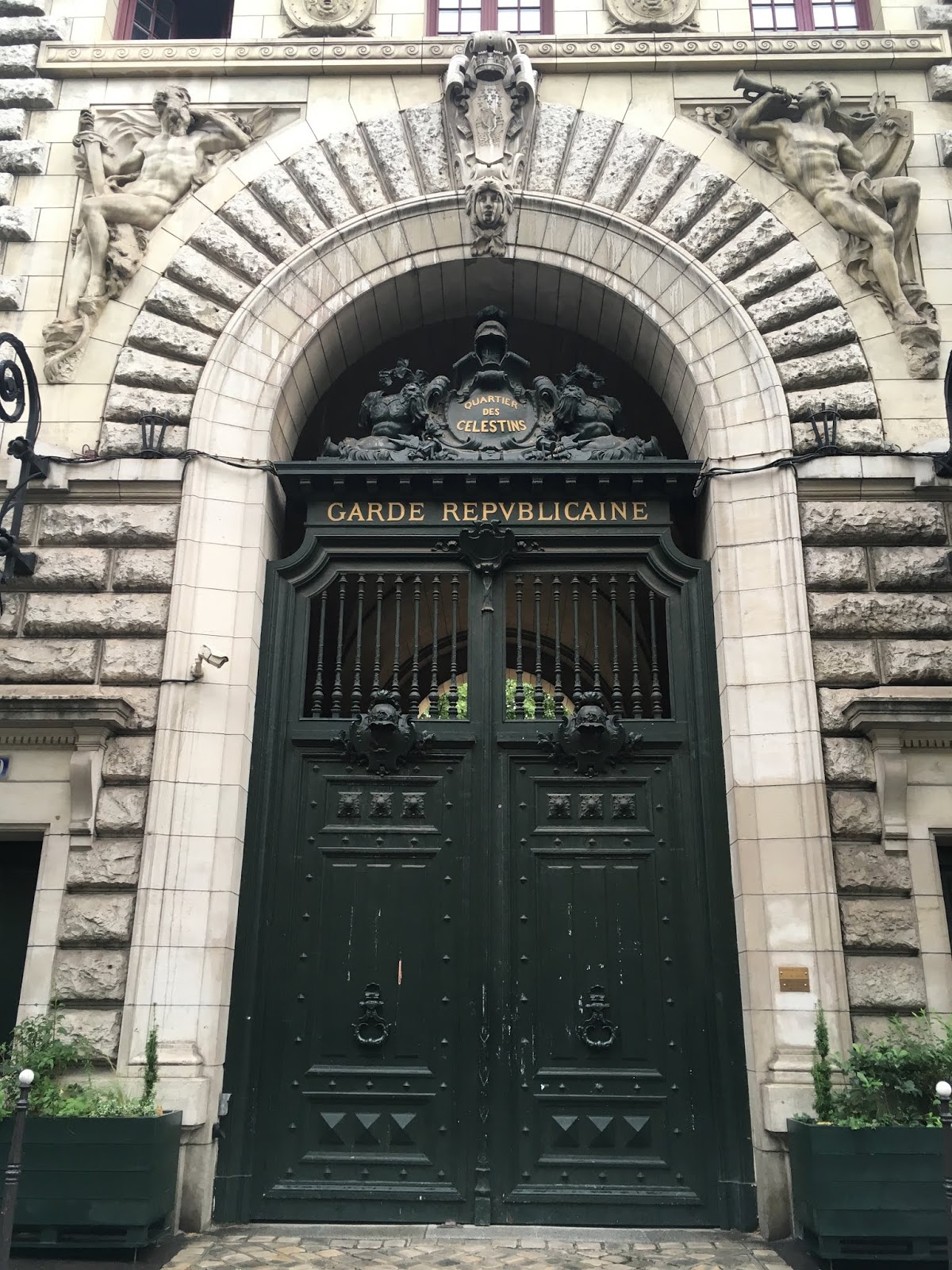
During my hunt for the library, I saw these impressive lanterns framing the doorway to the Horse Guards.

in search of the American Dream
Close-up of the lanterns. Aren't they beautiful? There are things like this to catch your eye all over Paris.

in search of the American Dream
Here's one doorway to the Horse Guards.


in search of the American Dream
In the entryway to the library, a stunning floor.

in search of the American Dream
Then go up these stairs...

in search of the American Dream
and up again...

in search of the American Dream
To the second floor, with big windows overlooking beautiful houses.

in search of the American Dream
Go down the hallway to the library...

in search of the American Dream
...and be told by the receptionist that you cannot take your backpack into the library. You have to store it in one of these lockers.

in search of the American Dream
In the room with the lockers is a spot for scholars to eat, overlooking a horse chestnut tree.

in search of the American Dream
Back to the library to be assigned a place to work. More next week! What do you think of this place so far? Comment below!