Sunday, November 13, 2011

New Orleans' Love Affair with the Fleur-de-Lis

New Orleans, or as natives express it, Nawlins, is so proud of its French heritage (not to mention its NFL football team and the LSU Tigers college team) that the fleur-de-lis (French for "lilly") is everywhere, made out of all kinds of substances, even water.  Believe me when I say it's EVERYWHERE.


Potholders got it.  The oven mitts have Louisiana crabs, crawfish and shrimp.

On shingles from homes destroyed by Katrina.


Coat hooks.


Evening clutch bags.

This one is for just because.

Iron hooks.

Necklace and earrings

This is a New Orleans Saints football hero on the roof of a tattoo parlor.  The tattoo artist gave the mannikin a fleur-de-lis tattoo on his left forearm.


A U.S. flag reconstructed with fleur-de-lis in black and gold, plus stripes.

The central group of lagniappe beads is fleur-de-lis.  All the strands are in black and gold (except for the footballs).  From left to right, footballs, little Mardi Gras masks, fleur-de-lis, black & gold, and a different type of mask.

Refrigerator magnets.

Even the water is shaped like fleur-de-lis.  This fountain is in Louis Armstrong Park.

According to Wikipedia:  While the fleur-de-lis has appeared on countless European coats of arms and flags over the centuries, it is particularly associated with the French monarchy in a historical context.  According to French historian Georges Duby, the three leaves represent the medieval social classes: those who worked, those who fought and those who prayed.[5]

It is also the emblem of the city of Florence, and of the Swiss municipality of Schlieren.

In North America, the fleur-de-lis is often associated with areas first named or settled by the French. In the US, they tend to be along or near the Mississippi and Missouri rivers. Some of the places that have the fleur-de-lis in their flag or seal are the cities of St. LouisLouisvilleDetroitNew Orleans, and Baton Rouge and the states ofLouisiana and Missouri.


Wednesday, November 9, 2011

Special Edition: Legendary Route 66

Here's the lyrics of the song, and I have pics of this legendary road for you.


If you ever plan to motor west, 
Travel my way, take the highway that is best. 
Get your kicks on route sixty-six. 

It winds from chicago to la, 
More than two thousand miles all the way. 
Get your kicks on route sixty-six. 

Now you go through saint looey 
Joplin, missouri, 
And oklahoma city is mighty pretty. 
You see amarillo, 
Gallup, new mexico, 
Flagstaff, arizona. 
Don't forget winona, 
Kingman, barstow, san bernandino. 

Won't you get hip to this timely tip: 
When you make that california trip 
Get your kicks on route sixty-six.


The full 2,000-mile road no longer exists, but parts of it still do, some of it as Interstate 40, and Flagstaff has some of it:
I hoped to see a tumbleweed out west and didn't see a single one, not even one caught in the fences along Interstate 40.  But this one came around the corner from historic Route 66 and tangled with my toes in Flagstaff.

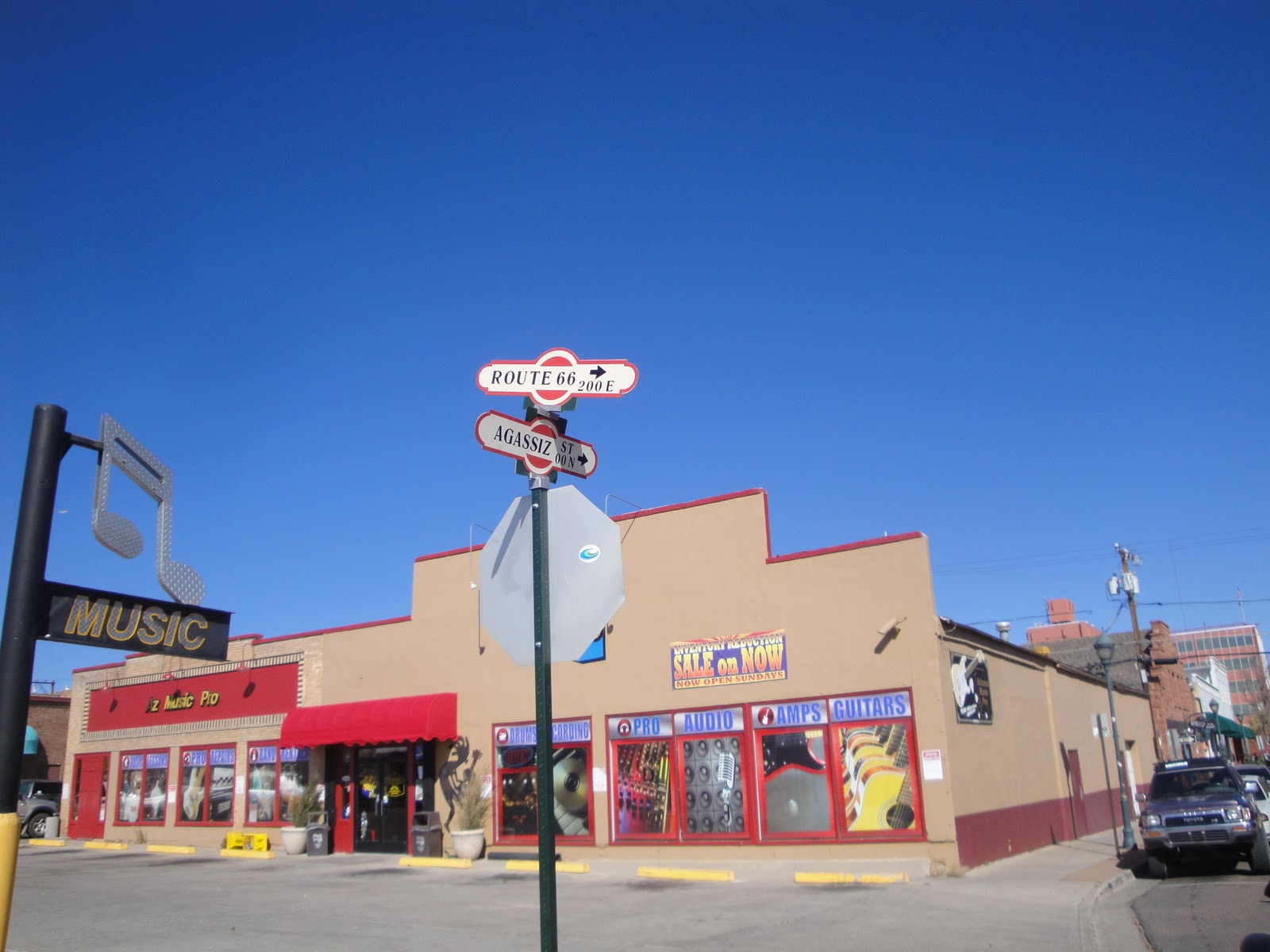
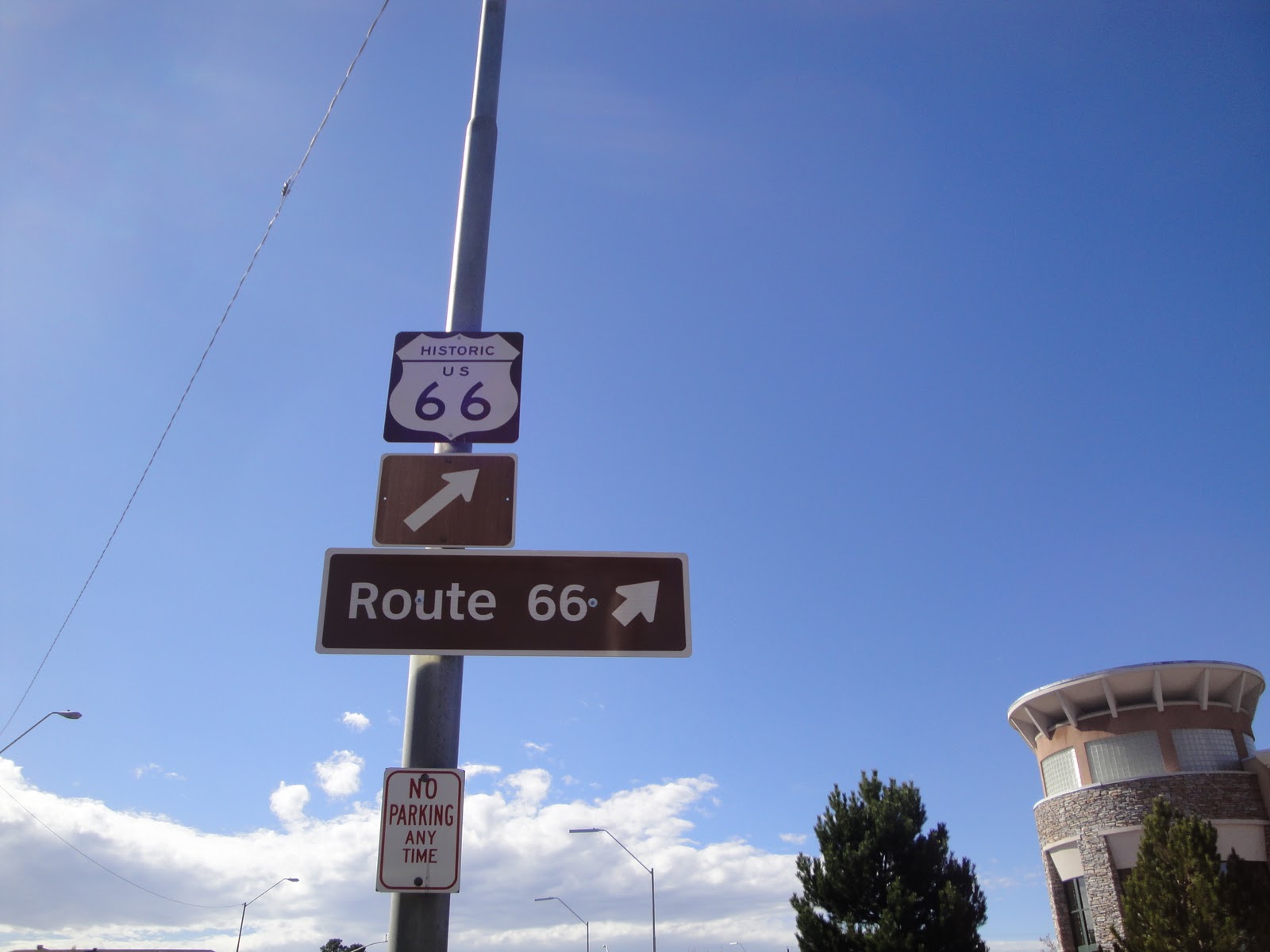
The road sign says "Route 66."

The scene in Flagstaff, AZ.  The tower in the lower right corner belongs to Barnes & Noble.

Route 66, aka Interstate 40, between Flagstaff and Albuquerque.

The bus stopped at a market in Gallup on Route 66/Interstate 40 on the way to Albuquerque.

The sun set behind me as I shot this stretch of Route 66 somewhere between Flagstaff and Albuquerque.

The hostel I stayed in Albuquerque was on Route 66 and named for it.


This is Route 66 in Albuquerque.  Lots of urban sprawl.

Route 66 looking at downtown Albuquerque.

Route 66 at twilight in Albuquerque.

Ditto.

Ditto.

Must be seen to be believed, on Route 66 in downtown Albuquerque.

Two darling people I met in the hostel on Route 66 in Albuquerque.

Route 66/Interstate 40 from Albuquerque to Amarillo, TX.  Dry, dusty desert.

Monday, November 7, 2011

Albuquerque is Kinda Quirky

Southwestern architecture - note the wagon wheel window.

Interior of an old church in the Old Town section of Albuquerque.

Even park benches carry the sun and sunflower theme.

A new kind of statue to bring tourists in, this one a wild west deputy sherriff.

But he has an eyepatch, like the west coast pirates.

An equestrian statue in the Albuquerque sculpture park.

An Indian warrior.

The gates to the sculpture park.

Old Town original adobe architecture.

Old Town adobe with a Spanish flair -- wrought iron windows and balconies.


I want pots like these for my flowers at home.

At the Albuquerque Botanical Gardens, a sculpture of two boys saving a cat.

I want a park bench like this one, too.

And a pot like this.

How's this for a park bench, hidden away in an alcove?

Albuquerque can be forgiven for not running its fountains, unlike Seattle.

The botanical gardens were full of LED light sculptures for a party to be held at Thanksgiving.  This one is of a blue whale.

A hummingbird.

Cool weather plantings in the botanical gardens.

The sunflower theme, continued.

Sunday, November 6, 2011

Seduced by the Grand Canyon

After hearing the Grand Canyon talked about for 50 years, I finally saw it myself.  My first overlook was underwhelming because the view at that spot was very narrow, but as I progressed along the southern rim, I fell deeper and deeper in love.

This man climbed through the fence to see more.

Rocks 300 to 500 million years old.  


Many Native American tribes called the area home.
 a
Alas, I have not seen an elk or a bighorn.  I did see ravens and a pinyon jay (peacock blue in places and very bold -- he flew to my feet to pick up a bit of dried papaya I had dropped, hopped through three trees and onto a rock to eat it.  I couldn't capture him well with my camera -- he always moved very quickly).


I filled my water bottles with Grand Canyon spring water.

Sunset.  This is the view a photographer named Kolb enjoyed for years from his studio (right), now a Park Service gallery.

A little more sunset.

By the time I had to leave, just after sunset to catch the bus back to Flagstaff, I could hardly bear to tear myself away from the Grand Canyon.  It was the first place I've been to that I thought, "I absolutely MUST get back here and see more and do more."  Then I met a Belgian girl in Albuquerque who said Bryce and Canyonlands National Parks in Utah are better.  Who has seen both?  What do you think?