Saturday, October 5, 2019

Life at the Water's Edge in Paris

By Norma Hopcraft

On my recent adventure to Paris this summer, I found myself gravitating toward the Seine.

To me, it's the most fascinating aspect of Paris--flowing through the city with its abundance of  péniches.  

These are barges. Some are work barges--family businesses carting coal and many other products around the canals and rivers of France.  

Some were converted to pleasure craft. Families live on them and cruise the canals and rivers of France for fun. Or they tie up in Paris (with permission of the authorities) and live within walking distance of Le Louvre and the many other treasures of Paris.

The canals and rivers of France offer a pleasure-boater 5,000 kilometers to explore.  In France, it's known as the patrimoine fluvial, or the fluvial heritage--an incredible gift from past generations, who dug the canals and connected the rivers. You can wind past ancient stone villages, through cities, past quiet fields of wheat or cows. My friend Cris Hammond did this -- please see the link at the bottom.

The  péniches that are converted look absolutely delightful. I've been welcomed on board two of them, and that experience is part of my novel, The Paris Writers Circle.  I'll show you some incredible péniches, below.


in search of the American Dream
I couldn't get the whole boat into the picture! But you can see it has a gangplank (in the center; it's raised) and bikes on the deck. Under the deck -- cabins! I'd love to be living in one of them!

Here's the other end of the barge. It has seating on the bow.

in search of the American Dream
Here's the seating area -- curved wicker chairs. Can you imagine the wonderfulness of sitting out there, watching Seine boat traffic go by, or tied up on a river or canal in the countryside, watching the sun go down behind an ancient church?


Bikes ready to explore Paris. I biked in Paris--once! Nearly killed myself.
Look at all the wires, cables, pulleys, winches.


in search of the American Dream
The gangplank is raised, and iron bars hold the barge away from the embankment, meaning that this family and the things they have left on the deck are quite safe -- a floating island.

in search of the American Dream
The masts have to be lowered to pass under bridges. These are the mechanics for doing that.

in search of the American Dream
Here are the mast supports and stays (thin steel lines that run from the hull to the top of the mast).

in search of the American Dream
Not easy to manage all this equipment.

This is the cabin, in the stern, where the captain operates the barge.

The barge is held off of the stone embankment by iron bars. The waters of the Seine are choppy with all the boat traffic making wakes, and without these iron bars, the hull would be damaged by the stones.

in search of the American Dream
A view of the stern.

The gangway is huge! 

Pont Neuf, "New Bridge," is in the background. It is now the oldest across the Seine, but it was new when it was built in 1578-1607.

The bridge is lined with gargoyles. They are 400 years old. Think of the generations that have walked across this bridge!

The gargoyles.


in search of the American Dream
There's constant traffic under the bridge, not just boats but people walking and on bikes on the embankment.


in search of the American Dream
Near Pont Neuf is Notre Dame, now shrouded in scaffolding. A symbol of resilience (my specialty). If you read my novels, you'll see my characters in all kinds of trouble -- most of that is from my own life! 

in search of the American Dream
This is the bow of a working barge. The boat is extremely long -- you'll see that over the next four pictures.

in search of the American Dream
Here's more of the hull...

in search of the American Dream
Still more of the hull...

in search of the American Dream
Still more of the hull....

in search of the American Dream
Still more of the hull...

And the cabin in the stern. Please note that there are curtains on the windows and a small life raft on the cabin roof. Some barges have cars on the roof (and a boom to lift them and swing them onto land). How about you? Would you like to travel around France on a barge? You can experience it vicariously by reading my friend Cris Hammond's humorous, delightful book about his first year doing exactly that! Read the first 3 chapters here: https://www.amazon.com/Here-Paris-laid-barge-France-ebook/dp/B00H055PNU/  Cris and I didn't talk about this--it's a surprise!


Wednesday, September 18, 2019

French Attic Windows

In Search of the American Dream in Attics


By Norma Jaeger Hopcraft, The Traveling Writer


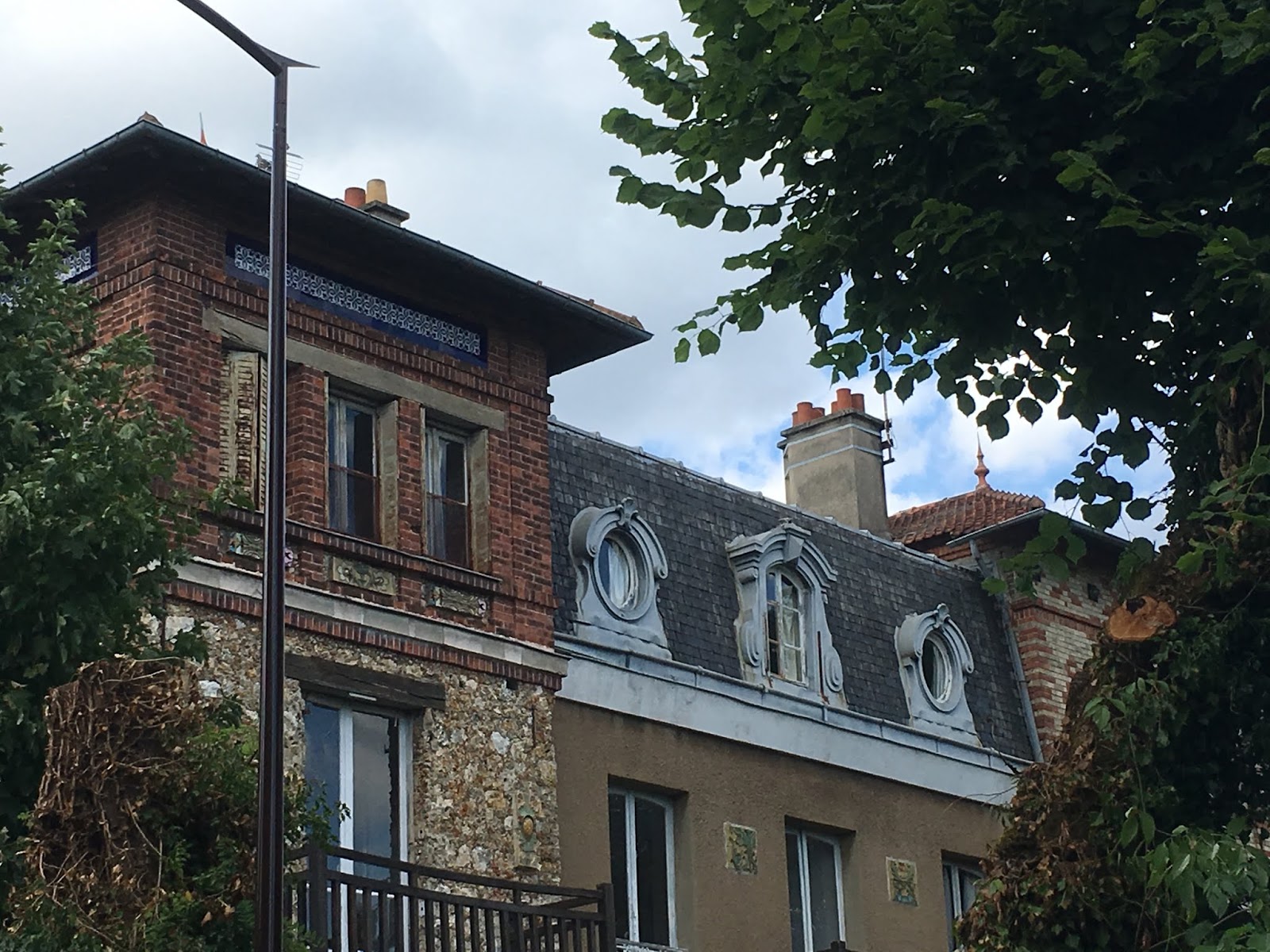
Imagine all that goes on in attics around the world! And to spark your imagination, I'm offering pictures of attic windows in Paris and in Viroflay, the suburb of Paris next to Versailles where I stayed this summer.

The French do attic windows in tremendous style, like they do so many other things.

What do I think of when I think of attics? Mr. Rochester's crazy first wife in Jane Eyre was an incredible attic dweller, completely secret even to people who lived in the house below her. She had wild hair, and when she was angry her lips and eyes became inflamed. Eventually she burnt Mr. Rochester's incredible home down.


in search of the American dream

Look at the top row of windows. Who lives up there now? What goes on up there? What scenes of seduction, murder, childbirth, played out behind those windows in the course of history? Maybe those windows never had a home behind them but instead were storage for papers from the offices below. What do those papers have written on them? What miscarriages of justice did bureaucrats come up with against their enemies that could be discovered today? The injustices would have been perpetrated centuries ago, with no way to even begin to make things right now.

We had an interesting attic in the big house I grew up in. It had an unheated, uninsulated attic, which my parents promptly stuffed with furniture and boat gear.

In one corner was a little room closed off, with a small radiator, a window, and a long worktable. My brother claimed it and used it as a radio shack at first, building short wave radios and listening to conversations from around the world. 

Eventually he moved in completely. The table was strewn with radio parts. The room smelled of solder. He hid out from the family there.

When my brother went to college, I immediately moved into the attic room. At this point the room held a dresser and a twin bed in addition to the long table. I would spread my papers out on the table. I opened up my portable typewriter. I sewed there. Or I laid on my bed and read. I would play my music loud. "Bridge Over Troubled Water" was a constant.

My poor mother used to climb two sets of stairs to knock on the door of my tiny room and tell me it was time for dinner. Teenagers! I was so incredibly self-involved, fleeing to my attic room, avoiding chores, so unwilling to help out with the work of a home and a family. 

I loved that attic room, though, and nowadays attic windows still speak to me. They evoke a feeling of creativity -- a space to spread out and make things. Quilts. Books. Blogs. 

in search of the American dream
So many attic rooms to choose from...I'll take one that gets sunlight.

in search of the American Dream
Look at the interesting roof shape on the left. That's the room I want, with the circular window.


in search of the American dream
Maybe you want an attic window that has a statue outside it.


in search of the American Dream
Here's that same attic, zoomed in on.


in search of the American dream
In some Paris buildings, the rooms under the eaves were for the hired help. A female maid is called a "bonne," and the room she stayed in was called the "chambre de bonne". These get rented out now. Often they're six floors up--no elevator and a shared toilet. 

in search of the American Dream
This is an attic window in Viroflay. Isn't it exquisite?

in search of the American dream
Here are two interesting attic windows in Virofly.

in search of the American dream
If I owned this house, I would open those shutters and let the light pour in.

in search of the American Dream
Same with this house.

in search of the American dream
More attic windows in Viroglay

Here's a modern house, with big sheets of glass for doors and windows.


in search of the American dream
An adorable attic -- let me up there!

A home in local Viroflay stone, with a French-style eyebrow window in the attic.

in search of the American dream
Wouldn't it be cozy to live behind that window, under those eaves?

Yes, a balcony of my own. Exactly what I need.


in search of the American dream
An older home in Viroflay, with local bricks and tiles.

How do they keep the shutters at those perfect matching angles?


in search of the American dream
This was taken in Paris. They attic overlooks the Seine. Can you imagine how much it costs to rent?

These attics look over L'Arsenal boat basin, near La Bastille.

I'd love to live in that attic, too.
in search of the American dream
Here we are in Viroflay again. 

in search of the American dream
Viroflay. The sun gives the local stone a warm glow. I crave to live in that attic! How about you? Do attic windows make you start to think about what goes on in that house? : ) Comment below!