Wednesday, September 26, 2018

American Dream: Find a B&B and Make Some Discoveries

The Traveling Writer Sees Quirky Things in Rhode Island

By Norma Jaeger Hopcraft


Last week I shared my Louisiana music festival with you. I want to recommend Zydeco again! A week ago I invested in a C.J. Chenier live recording made at the New Orleans Jazz Festival.  I’m glad I did. His showmanship is obvious even when he’s not making music on a stage. And his Red Hot Louisiana band doesn’t play a single note that isn’t red hot.

While attending the Rhythm and Roots music festival (the largest gathering of Louisiana musicians outside of Louisiana) in Charlestown, RI, I stayed with my sister in a bed & breakfast in Kingston, RI.

We went for a walk one morning and found out it’s a college town, the University of RI at Kingston. We drifted onto campus and found an arboretum with a fantastic assortment of exotic trees. They were all labeled with their English name, Latin name, and area of origin.

Everyone in my family is a plant nerd, so we really appreciated that somebody, at some time, planned this place, took care to ship in trees that were likely to survive Rhode Island winters, and took the time to make sure each tree had a label.

This arboretum is a great, humane legacy that some person or persons created and shared. I admire that legacy-building instinct, and I’m grateful for it.

Let me share some quirky pictures of the weird trees. I have pictures of the labels for some, not all. Then we'll get into the bed & breakfast.
The Traveling Writer in Search of the American Dream
Look! A tree in camo!

The Traveling Writer in Search of the American Dream

The Traveling Writer in Search of the American Dream
This tree has beautiful bark in flowing lines.

The Traveling Writer in Search of the American Dream
This blue beauty is a Korean fir.

The Traveling Writer in Search of the American Dream
Here it is in close-up.

The Traveling Writer in Search of the American Dream
Not sure of the name, but it sure looks like green fireworks.

The Traveling Writer in Search of the American Dream
This is a larch, from Central Europe. A bit quirky-looking.


The Traveling Writer in Search of the American Dream
There were neat gates and structures throughout the arboretum.

The Traveling Writer in Search of the American Dream
Not sure what this is, but it sure does have strange roots.

The Traveling Writer Recommends the Sheppard B&Bs


We stayed at Sheppard’s Campus B&B, run by the Sheppard family. It was in an appropriately Victorian house and decorated with antiques. I always enjoy looking at this type of house and furniture, and I enjoy even more thinking how glad I am not to have to take care of any of it.

We had two terrific breakfasts and enjoyed the company of our fellow guests. We also enjoyed exploring the grounds.


The Traveling Writer in Search of the American Dream
A splendid house, both inside and out.

The Traveling Writer in Search of the American Dream
I love the weathered brick.

The Traveling Writer in Search of the American Dream
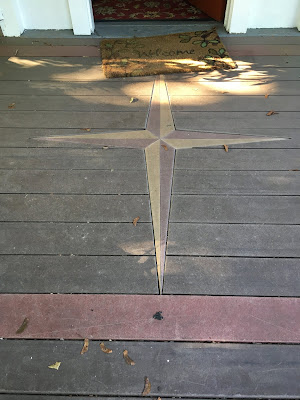
A compass rose built into the porch floor.

The Traveling Writer in Search of the American Dream
Tons of antiques and healthy potted plants.

The Traveling Writer in Search of the American Dream
A bird cage from India. Felt quirky to find it in Kingston, RI.

The Traveling Writer in Search of the American Dream
Close up of the front door.

The Traveling Writer in Search of the American Dream
Splendid hydrangeas, and all kinds of other beautiful plants, in the gardens.


One of the Sheppards had created a lovely garden around the house. Since I used to be a passionate gardener, and my sister developed one worthy of a House and Garden spread, we made a point of exploring the garden’s paths and noting the different foliage combinations that this gardener had fostered.

I sat in one of the seating areas to make a phone call and to just soak up the sight of sunlight on leaves. This is something I starve for in my life bouncing between Brooklyn and Manhattan. It’s one of the most gorgeous sights on earth, and this peaceful garden filled my soul up to the brim. Then a groundhog came out from under the porch and sat in the sun, to top it all off.

How about you? Been to a good B&B lately? Comment below!

Saturday, September 15, 2018

The Traveling Writer Spends Proceeds of Her American Dream

The Traveling Writer Goes to a Music Festival -- Her First Ever!


By Norma Jaeger Hopcraft


I’d like to divert your attention momentarily from Barcelona to Rhode Island, where I attended a music festival over the Labor Day weekend. It was the biggest gathering of Louisiana musicians outside of Louisiana. It was my first music festival ever--that's if you don't count the concert I went to in the Bronx when I was 14. When the first act came on stage, people on every blanket around me and my friend Rich lit up or downed some pills with alcohol, or all of the above--but you know what I'm talking about : )

This RI music festival was so much fun!

At the ticket counter, I could see that nobody was going to take him- or herself too seriously this weekend. 


The Traveling Writer in Search of the American Dream
The black-and-white checkered sunglasses make the look.

The Traveling Writer in Search of the American Dream
Or maybe it's the Mary Janes...

When I walked across the field to the dance tent and heard Zydeco music kick in, my heart—no kidding—leapt for joy. Zydeco is THE most infectious dance music in the world. I took a Zydeco dance lesson with the accompaniment of the Zydeco Hogs. I highly recommend their recordings. Your feet will begin to bop in spite of yourself. It won't stop there. Knees, hips, shoulders are quick to bop.

The Traveling Writer in Search of the American Dream
The washboard player herself can't resist dancing to the Zydeco.

The Traveling Writer in Search of the American Dream

I also danced to Steve Riley’s music. This is him as a child.

 I particularly enjoyed CJ Chernier & the Red Hot Louisiana Band, who is carrying on his father’s tradition. What a fantastic showman CJ is! And honey, he and his band are red hot. He loves people, loves to give his audience a good time, and gets the musicians and the crowd all riled up : )

Blues, Zydeco, country, Western, bluegrass, Cajun: the Rhythm and Roots festival in RI has it all. Sign up for it as soon as you can!
One show had some musicians that you could look at and tell: they had traveled the back roads of the bayous to play at dance halls for the last 50 years. They were goooood!

A group called Faux Paws was extraordinary. Young musicians on their way to being legendary, in search of their American Dream

I truly enjoyed the show on Sunday called “Sunday School with Christine Ohlman, Rebel Montez and the Sin Sisters.” I wondered if this was an ironic title, whether a coven of witches would show up.
The Traveling Writer in Search of the American Dream
The Sin Sisters, back-up vocals for Christine Ohlman.

The Traveling Writer in Search of the American Dream
 Christine Ohlman and Rebel Montez


Turns out Christine is my kind of Christian. With back-up singers called the Sin Sisters, how could she not be? She defies any pigeon hole of Christianity anybody, including church ladies, could try to wedge her into. She’s singing truth according to her artistic insights, free in God's great artistic freedom to not try to meet expectations of what she should look, act, or sing like. She’s a singer, songwriter, guitarist, recording artist, and music scholar. Her nickname is "The Beehive Queen.” I also approve of her shades.
She treated us to one bluesy, gutsy, beautifully rendered song after another. And she started me on a trail of other artists. She referred to Aretha Franklin, Percy Sledge, Ben E. King and Curtis Mayfield. All treats to be enjoyed because Christine played some of their songs and credited them with enthusiasm.

The Traveling Writer Searches

I love to be not only on a music trail but a reading trail as well. A writing friend recommended George Orwell's "All Art is Propaganda" and that led me to his "Homage to Catalonia" and "Down and Out in Paris and London." I heard of Tracy K. Smith because she was a recent Poet Laureate of the U.S., and that led me to her memoir. I recently enjoyed Doris Kearn Goodwin's "Lincoln," and soon that will lead me to her book on Franklin and Eleanor Roosevelt and World War II.

I love these avenues of exploration. How about you? You following any trails lately? Comment below!

Saturday, September 1, 2018

The Traveling Writer vs. Kids in Barcelona

Persistence in Search of the American Dream

By Norma Jaeger Hopcraft


Dear fellow adventurers,


Please take a look at a fun (nearly manic) essay I wrote about perseverance, in which I admit to many things, including the idea that I may be more talented at perseverance than anything else in life : ) It's here, on ChangeThis.com, also known as CEO Reads.


Also, I’m quoted recently in The Washington Post travel section, in an article about rental car mistakes to be avoided (i.e., the one I made). Check it out here. 
Now, for some photos of Barcelona, a spectacularly beautiful city. Then this week’s story – see exactly how some other Spanish kids exhibited their disrespect to me.

the traveling writer in search of the American Dream
-->
These pics are all from the Plaça Milicia del Desconegut. Styles from different periods of Barcelona's history stand shoulder to shoulder.

the traveling writer in search of the American Dream

the traveling writer in search of the American Dream
A mysterious doorway -- ooooo, what Catalan princess swooned here for her crazy Spanish suitor?

the traveling writer in search of the American Dream
Catalan flags draped on balconies in the plaza.

the traveling writer in search of the American Dream
Great hulking buildings -- what scenes of human travail has this one witnessed?

The Traveling Writer Resumes Her Theme

My friend May, a professor of economics and avid writer herself, replied to my last post that I was making a generalization about Spanish children. I agree with her that generalizations are dangerous to make, especially about people—not only dangerous for the people being stereotyped but also for the person making the stereotype. Generalizations / stereotypes cut us off from the richness and variety and truth of the situation.


But today I’ll tell you about some other kids in Barcelona that I taught and what happened. I’ll also quote two other adults who work with Spanish children. Then we’ll agree to not generalize about all Spanish kids.


While I lived with the 3 feral boys, some friends of their family stopped by. They seemed like nice folks, nice kids. They wanted me to teach their two girls English twice a week, on their lunch break from school. My employers said OK, so I said OK, very glad to have 30 euros in my pocket after every lesson.


Then the families stood around talking to each other in Catalan, and I just stood there, being polite and smiling and not understanding a word. Then one of the two girls I’d be teaching began doing something I’d never seen before, and it horrified me.


She lay down on the tile floor on her back, and lifted her feet up toward her father’s legs, and very slowly and incredibly gently lowered the soles of her feet onto his thighs. It wasn’t so much the action itself as her attitude. She exuded disrespect – she was doing this to lower her father. To me it was quite clear. We all read people’s attitudes every day. I think that I can read as well as the next person and that you would have gotten the same impression.


But I had agreed to teach, and I thought I might be able to handle two girls better than three boys that operated like a pack of wolves.


So I picked the girls up from school a few days later.


We walked toward their house, which was high on a hill and overlooked the blue Mediterranean Sea. To get there, we had to pass a fenced-in pasture where Calçot, a donkey, lived all alone. (His name means Green Onion in Catalan, by the way). There was tall grass along the fence, and some of it had turned brown in the intense autumn sun.


I walked ahead of the two girls, who kept a leisurely pace behind me. They weren’t in a big hurry to do more schoolwork, that’s for sure.


Well, the lesson went pretty well. The younger girl started to put her feet on me under the dining room table and I grabbed her ankle and said “No!” very firmly. She tried again another day, but on this particular day I didn’t feel her feet brushing my leg any more. The younger girl was very reluctant to participate in the games,  was slithery on the couch, made it clear she didn't much care. But with cajoling we got through the games in English that I had prepared. The older daughter seemed to have much more fun--and less of an issue with showing disrespect.


When the mother arrived home from work, I asked the girls to do the games again, to show their mom they had learned something. Then she paid me, and the 30 euros felt like bliss in my pocket. I scooted down the hill, past Calçot, and arrived on the terrace of the boys’ house with time left in the day to write.


As I wrote, I paused and touched my hair. I felt something prickly stuck there. It was bits of dried grass. How’d that get there, I wondered to myself. Then I felt another piece.


I jumped to my feet. There were bits of dead grass on the back of my head and the back of my clothes, from head to toe.


Those girls. They just had to show disrespect to an adult. It was their biggest preoccupation, evidently.


The Traveling Writer Persists in Search of the American Dream

I vowed to never walk ahead of them again.


But those 30 euros were wonderful. I would teach them again. And I would insist that those feet not rest any part of my body.
Now I’ll tell you about two other adults I talked to about the disrespect they experienced from Spanish children. One was my pastor at a church in a neighborhood of Barcelona called Gracia. The church was Eglise de Gracia, a play on the neighborhood name and the grace of God. The pastor’s name was David, and I asked him for advice to deal with the 3 boys I lived with and their disrespect.


“I used to coach my sons in football,” he said. Football is known as soccer in the U.S. Barcelona has a world-famous soccer team.  “I did it for two years, but the boys I coached were so disrespectful to me that I had to give it up.”


So there’s that. And there’s the quote I gave you in the last post, from a Barcelona native: “Los niños en España respetan nada.”


And then there’s the beautiful American woman I met at church, Stephanie, who translated David’s excellent sermons from Spanish to English for me. She was a teacher in an elementary school in Barcelona. She said the disrespect was constant, viral, feral, and hopeless. 

“I just do the best I can,” she admitted, “but it’s really awful, and awfully hard on me.”


That’s how I felt too. Next post, in two weeks: more stories of disrespect. Then maybe we’ll move on. How about you? Do you insist, like my friend May, that I ought not to make generalizations about Spanish children, or even just Barcelona children? We agreed at the top not to generalize, right? Okay, shall we stick to that? : ) Comment below!

Thursday, August 16, 2018

Life with a Catalan Family in Pursuit of my American Dream

Life in Catalonia for the Traveling Writer

By Norma Jaeger Hopcraft

I lived with a Catalan family as an au pair for three months and it was quite the experience.

When the father picked me up with my three pieces of luggage, he drove a Lexus. I was surprised because I'd heard so much about Spain being a drag on the European Union.
I asked him his line of work. He was a consultant to CEOs of Spanish companies, he said, and the secret to helping these CEOs was to help them to see just how big an array of options they had.

As we drove through the gates to the family's home, we passed a swimming pool and a huge Mercedes van. The house was enormous -- three stories, all white with an orange tile roof, a verandah across the front, white steps up to the verandah. Inside, with all the white tile floors and cement walls, the house echoed.

He helped me with my luggage, bless him, and asked his youngest son to show me to my room.

"Welcome home," the father said.

The littlest guy led me up a big staircase, down the hall, past the three boys' bedroom to mine.  The room was pleasant -- a twin bed, a table next to it with a lamp for reading, a desk, a big closet, a big window overlooking the terrace. I thought I'd really lucked out.

Later that night, I came back to my room and found a wad of chewed gum on the bottom of my laptop.

The disrespect only got worse.

The mother and father spoke to me in respectful enough tones, but their three sons were insane with disrespect and the parents did nothing to correct them. They believed, obviously, that every option should be open to their boys at all times, including outrageous disrespect of others.

Let me give you just two examples.

I went with the three boys to their grandmother's house for lunch. She served us chicken legs that she had roasted in the oven and were quite greasy. The youngest boy, age 3, ate the chicken with his hands.

When he was done, he came around the table to stand between his grandmother and me. I watched as he put on a little act. He looked at his greasy hands, reached for the tablecloth and decided not to wipe his hands there, reached toward the roll of paper towels and pulled back, deciding not to wipe his hands there, and then a look of pleasure came into his eyes, and he rubbed his dripping fingers down my bare arm.

"Nico!" his grandmother said in an indulgent tone. And that was that. No correction, no "I'm sorry, let me help you." I was on my own to deal with it.

That was the story in this Catalan household. The kids treated me, the maid, the office staff that worked with their mother--all of us--as the most contemptible vermin in the world. One day Nico went so far as to gather spit in his three-year-old mouth, getting ready to launch it at me. I tapped his cheek with a "No!" and moved out of range.

The boys were raised to never say no to any option. Jump from dining room table to sofa to floor. Fine. Handle a brand new camera with greasy fingers. That’s okay. Dump out every box of Legos. Fine. The maid will pick it up. Nothing was off limits. “No” was never said to them. I saw the results.

The boys were a nightmare. Feral. Mean to me and devilish mean to each other. I knew deep in my gut that the parents did not see any problem with their beloved children and would never correct them or support me.

I was sad for the boys, to grow up looking at everyone, even their own brothers, through lenses of contempt.

I felt sad for myself, having to deal with a steady flow of disrespect from each boy. I tried to find ways to teach them to respect me. I was on Skype almost nightly with friends who had been teachers in the States, asking for advice, for a technique, for some way to swim in this sea of contempt. I asked new friends in Barcelona what to do.

“Los niños en Espagna respetan nada,” was their answer. It was country-wide. I saw it for myself at the playground, among the boys’ friends.

I felt sad for all these kids, for their grandparents, for Spain. How can a child learn from anyone he doesn’t respect? What kind of employees could they be if they had no respect for those in authority? What kind of old age would the grandparents have as the object of scorn from feral grandchildren? These kids – this nation – were at an incredible disadvantage, unable to learn from teachers or elders of any sort.

 But I Continued In Search of the American Dream


I escaped from the boys every morning at nine when I dropped them off at school. I wrote all day long on the terrace of the house. This was why I persevered – because I got room and board free and could write full-time in exchange for being exposed to these awful human beings for no more than five hours a day. I would pick them up at six from school with dread. But Saturdays and Sundays I was free! So I explored Barcelona. It’s an amazing city. You must go.

Just avoid Spanish children.


The roof of the colonnade at the 14th century hospital, now the Biblioteca de Catalunya.


The courtyard outside the library.

A mysterious door in the wall of the library. What sorts of things happened behind it since the 1400s?

The stairs up to the library's door. I was robbed on these stairs, but that's a story for another day.


The vaulted stone and wood ceiling of the library. This is the juncture of two wings. I wrote and edited big chunks of The Paris Writers Circle under this beautiful ceiling. The milieu of the library inspired me. How about you? Been to Barcelona? Want to go? Love inspiring spaces? Comment below!


Wednesday, July 25, 2018

I Went to Barcelona In Search of the American Dream

How the Traveling Writer Ended up Living in Barcelona

By Norma Jaeger Hopcraft


This week I tell you the adventure story of how I ended up living in Barcelona after a year in Paris. 

It started with Paris in winter. On November 1, it was as if some celestial being put a hand on a dimmer switch and steadily, then increasingly rapidly, reduced the amount of light. 

Paris is a lot more north than New York City, which means summer evenings are much longer and winter days much shorter. I was accustomed to things getting lighter at about 6:30. and the sun being up, shining through my commuter train window, by 7. In Paris, things don’t start getting light until 7:30, and the sun doesn’t rise until 8. That extra hour of darkness in the mornings just about killed me. 

And in Paris, once the sun is up, it’s usually blocked by huge thick clouds. Also, the light is dim because the sun is low – not even rising above the roofs of two-story buildings. I was so starved for light that I would watch for a sunbeam to strike the ground outside my studio apartment window. When it did, I learned I had to run out and bask in it immediately because it wouldn’t last long. 

Sometimes I was in the library in Le Marais and had to dash out to the street, stand on the corner with my face to the weak sun. People would bump me in annoyance, but I didn’t care. I was doing a survival tactic. When the sun came out, it would only last a few minutes. Then moisture from the earth would rise, or the clouds would shift, the sun would be blocked, and a sunlit moment wouldn’t occur for another couple of days. Or weeks. 

By December 1, I felt ill with lack of light. People told me to take Vitamin D-3 and to burn candles all day indoors. “That’s how the Swedes get through the winter,” said someone who had lived in Sweden for two years. Candles didn’t cut it. Vitamin D-3 didn’t either. Standing in an occasional sunbeam for five minutes didn’t do much for me. I was suffering. 

I decided that I would never be able to live through a winter in London or Dublin or Stockholm or Copenhagen or Berlin. Nothing further north than Paris. Not ever.


Tres elegante! The skies were rarely clear in winter, however, making for feelings of desperation for light.

There are no right-angle intersections in Paris. Instead, delightful buildings like this one perch on odd-shaped corners.

Just outside Notre Dame, a woman dressed like a bride.  She wandered off, and so did the horseback- mounted policeman and the child.


Paris winters aren’t bitter cold usually—the temperature held steady at 33 degrees the winter I was there—but the lack of light makes life difficult. What to do to feel better? Go someplace sunny in the south. This is why Northern Europeans have been going to Italy and Spain and the South of France for centuries. 

I got on that bandwagon. I decided to check out Barcelona in January. A bright spot of sun to look forward to halfway through the winter would help me make it to spring. 

I took the Train Grand Vitesse (“Very Fast Train,” literally) to Barcelona on my birthday. I stayed in a hostel not far from the main tourist attractions. The city was sunny! It was in the low 50s in daytime! I sat on a bench in the sun and basked.


Serendipities while in search of the American Dream 


Now comes the Higher Power / serendipity part of the story. In the hostel I stayed in, I sat at the row of computers one evening to check email. A handsome young guy sat next to me to do the same, and we got to chatting. I said my one-year creative writing sabbatical in Paris was half over, and I needed to start planning my next step. I wanted to stay in Europe, but I had no idea how I could do that. 

“Check out Workaway.com,” the kid said. “In exchange for room and board, you give a certain number of hours per day to a farmer or a family. Check out the jobs. They’re all over the world.” 

He was right. There were hundreds of jobs. I could work on an organic olive tree farm on Crete, or a kangaroo ranch in Australia, or be a nanny to kids in Spain--in Barcelona to be exact. 

One ad said that the three boys in the family were in school nine hours a day, and I would have weekends free. That meant I could keep my writing life going! I could write while the kids were in school. 

I looked for a similar job in Paris, but the winter there had been so difficult for me, I didn’t look all that hard. I wanted an adventure in a sunnier location. I checked for a Meet-up in Barcelona of a writers group in English, and there was one! I had what I needed! 

I got in touch with the Barcelona family immediately, and after a few months the whole thing was in place – the nanny job, the Spanish visa, the Very Fast Train reservation to Barcelona in July. Here's a few scenes from Barcelona:


A mysterious Catalan courtyard


Exquisite wrought iron and architectural details.

A narrow doorway onto a narrow walkway. Perhaps a Catalan princess mourned her true love here?

Don't you wish you lived here?


 Next week: the challenge of being a nanny to three Catalan boys.

Saturday, July 14, 2018

In Search of the American Dream: a coffee shop, a new but forever friend, and...


How I Gained a Sponsor in France

By Norma Jaeger Hopcraft

I'm hoping you'll come on a journey with me, the Traveling Writer!

Here we continue the story of how I got to live in Paris for a one-year creative writing sabbatical...

I was hoping so much to get to Paris. I carefully calculated expenses, then converted everything to euros. At that point, the exchange rate was steep: 1.35 US dollars to buy 1 euro. It caused me some anxiety. I could just barely make it at that rate. What if it went up?

It was serendipitous when it finally changed to 1.15 to 1--and stayed there.

In hopes of someday being in Paris, I studied French online – “Learn French with Vincent.” It was a terrific course of study. I learned that the French do not have a word for “ninety.” Instead they say, “four times 20 plus ten.” It seemed a bit cumbersome to me, but it was their language, who was I to judge?

I was filling out the forms for the French visa – they were in French, so I had to use Google Translate to make sure I was filling out the blanks correctly.

But there was one big hole in my visa application: I still needed a French sponsor. All my networking with church friends had not provided one. I’d been told by my one contact in Paris, the pastor of a start-up Protestant congregation in the Latin Quarter, that I needed to find a homeowner in France.

How does one go about doing that, exactly? Even in our miraculous age of technology, it would be impossible to find a trustworthy landowning French person who would trust ME enough to write a letter to their government that basically guaranteed that, if I became destitute, they would keep me off the streets and out of the French government’s hair.

It was a sticky problem I couldn’t solve on my own. So I asked HP for help. Weeks went by. 

I explored coastal Connecticut on occasion and went back to New London, Stonington, all the picturesque places that reminded me of my mom and dad's twenty years in Mystic.


Mystic has tons of adorable houses and gardens.

It wouldn't be coastal Connecticut without whaling vessels.  Here's the Charles W. Morgan, restored as a whaling ship, docked at the public pier in New London, CT.

People swarmed over the ship.

19th Century sailors added to the festivities.


An 19th century sailor scooting back to the pier.

The ship's wheel, a rather important feature.

It wouldn't be an 19th century ship without tiny bunks and people saying, "How did they fit?"

More pics of coastal Connecticut here.

On Memorial Day I took a break from cleaning out my mother’s condo and went to the Green Marble Coffee Shop in Mystic for elevensies. 

I was sitting at the outdoor tables, sipping the best coffee ever – Sumatran Italian Roast – when I saw a woman approach the door of the coffee shop.

“She seems like an exceptionally nice person,” I thought. “It would be nice if we had a chance to chat.”

The Search for the American Dream Takes a Twist


She came out a few minutes later with coffee and a newspaper. She “happened” to pick the table and chair next to mine.

“America in Denial” was the huge headline.

“What’s America in denial about?” I asked her. Seemed like a great opening gambit.

It turned out well for me.

“Gun control,” she said, and we so easily started to chat. I really liked this person! She was a wonderful human being. We were enjoying great rapport, trading stories and jokes. So when she asked me what I was up to, I answered honestly.

“Well, my mother just died two months ago. I’m cleaning out her condo for my brothers and sisters – her home is unbelievably jammed. Anyway, I’m working on that but I found this book. A Writer’s Paris. It says if you’re an American writer, you really have to go live and write in Paris. I want to very badly. I have the opportunity now. But I need a sponsor, and it has to be someone who owns property in France.”

There was a bit of a pause.

“I own three properties in France,” she said.

I felt as though the sun stood in place for an hour. I sensed that HP was on the move again!

We talked about it, and I knew it would be a huge risk for her to trust a total stranger to uphold her reputation with the French government.

I invited her and her boyfriend to meet me for dinner for three nights later.

We met at the Captain Daniel Packer Inn in Mystic and talked some more. Once again, my impression of Hope was that she was an exceptional human being, that she was very much considering sponsoring me.

During dinner she said that her former husband, a Frenchman, and she had been divorced several years ago but that they still jointly owned a house in the Paris suburbs, a chalet in the French Alps that was inaccessible five months a year, and some other land. She laid it all on the line and said that at her word, he would be willing to sponsor me for my visa to France!

It was a night for lots of thank you’s to HP.

I went back at it with the French paperwork. I asked Hope’s former husband to provide a copy of his mortgage, his gas or electric bill, his French ID card, and a signed letter that he’d keep me off the streets.

The leap of faith both these people took is still stunning to me. Would I have done the same for a stranger? Hope and her ex are very fine people and set a high example for me.

Needless to say, I’ve kept in touch with her and sent her an honorary copy of The Paris Writers Circle. It probably wouldn’t exist except for her and her ex.

Next week: my favorite pics from Paris, and how I ended up living in Barcelona after a year in Paris.