Wednesday, November 9, 2011

Special Edition: Legendary Route 66

Here's the lyrics of the song, and I have pics of this legendary road for you.


If you ever plan to motor west, 
Travel my way, take the highway that is best. 
Get your kicks on route sixty-six. 

It winds from chicago to la, 
More than two thousand miles all the way. 
Get your kicks on route sixty-six. 

Now you go through saint looey 
Joplin, missouri, 
And oklahoma city is mighty pretty. 
You see amarillo, 
Gallup, new mexico, 
Flagstaff, arizona. 
Don't forget winona, 
Kingman, barstow, san bernandino. 

Won't you get hip to this timely tip: 
When you make that california trip 
Get your kicks on route sixty-six.


The full 2,000-mile road no longer exists, but parts of it still do, some of it as Interstate 40, and Flagstaff has some of it:
I hoped to see a tumbleweed out west and didn't see a single one, not even one caught in the fences along Interstate 40.  But this one came around the corner from historic Route 66 and tangled with my toes in Flagstaff.
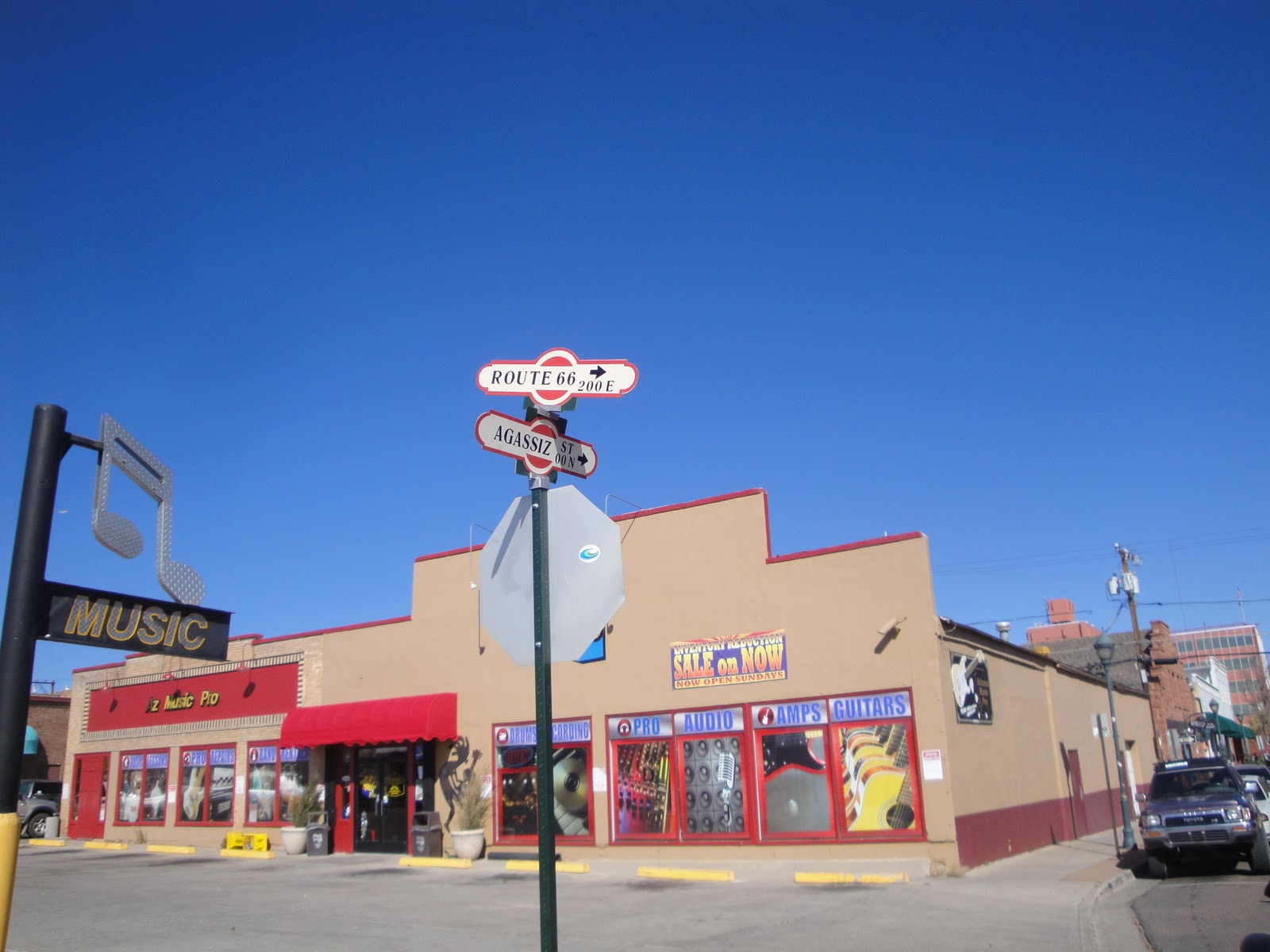
The road sign says "Route 66."
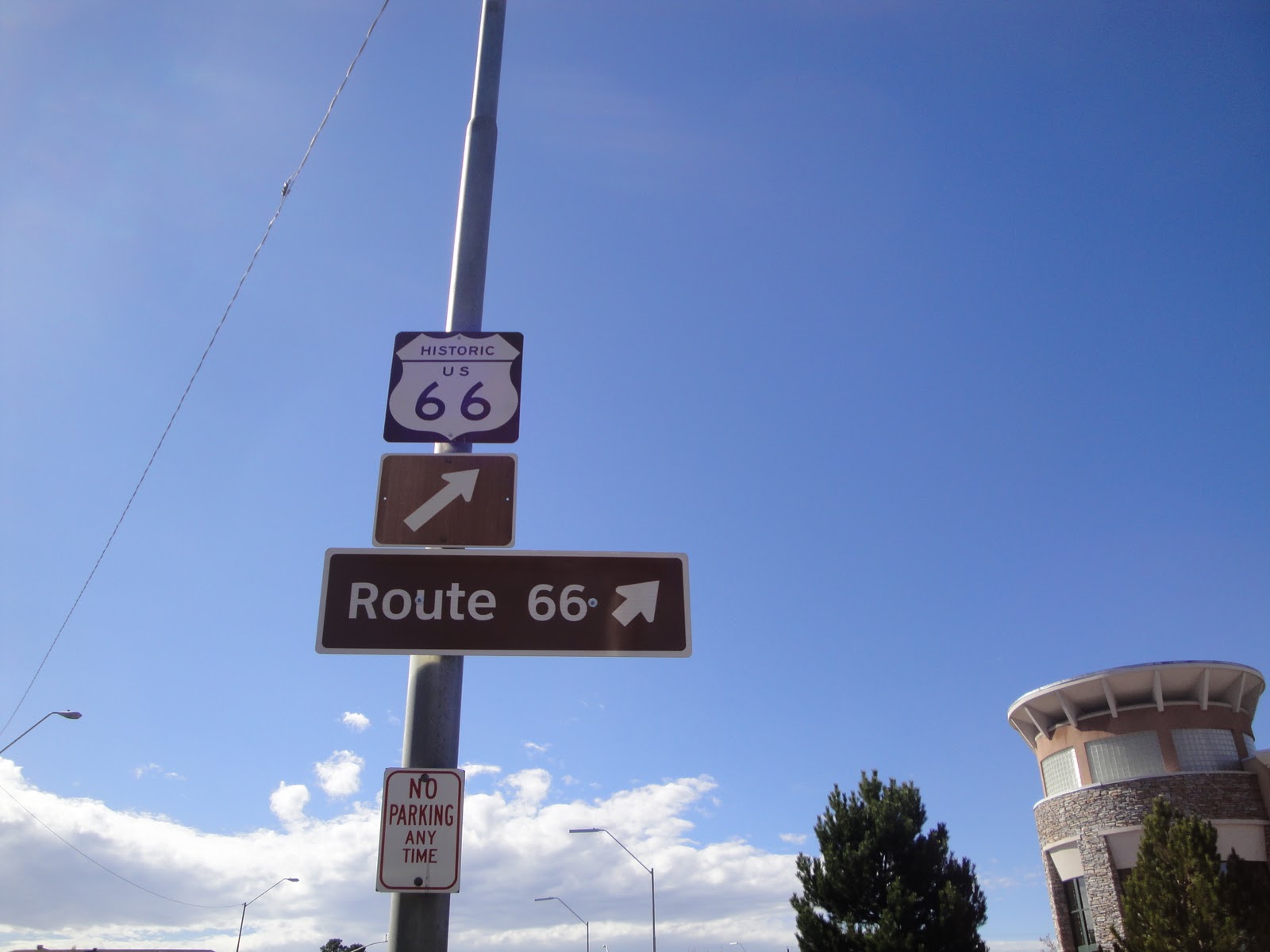
The scene in Flagstaff, AZ.  The tower in the lower right corner belongs to Barnes & Noble.

Route 66, aka Interstate 40, between Flagstaff and Albuquerque.

The bus stopped at a market in Gallup on Route 66/Interstate 40 on the way to Albuquerque.

The sun set behind me as I shot this stretch of Route 66 somewhere between Flagstaff and Albuquerque.

The hostel I stayed in Albuquerque was on Route 66 and named for it.


This is Route 66 in Albuquerque.  Lots of urban sprawl.

Route 66 looking at downtown Albuquerque.

Route 66 at twilight in Albuquerque.

Ditto.

Ditto.

Must be seen to be believed, on Route 66 in downtown Albuquerque.

Two darling people I met in the hostel on Route 66 in Albuquerque.

Route 66/Interstate 40 from Albuquerque to Amarillo, TX.  Dry, dusty desert.

Monday, November 7, 2011

Albuquerque is Kinda Quirky

Southwestern architecture - note the wagon wheel window.

Interior of an old church in the Old Town section of Albuquerque.

Even park benches carry the sun and sunflower theme.

A new kind of statue to bring tourists in, this one a wild west deputy sherriff.

But he has an eyepatch, like the west coast pirates.

An equestrian statue in the Albuquerque sculpture park.

An Indian warrior.

The gates to the sculpture park.

Old Town original adobe architecture.

Old Town adobe with a Spanish flair -- wrought iron windows and balconies.


I want pots like these for my flowers at home.

At the Albuquerque Botanical Gardens, a sculpture of two boys saving a cat.

I want a park bench like this one, too.

And a pot like this.

How's this for a park bench, hidden away in an alcove?

Albuquerque can be forgiven for not running its fountains, unlike Seattle.

The botanical gardens were full of LED light sculptures for a party to be held at Thanksgiving.  This one is of a blue whale.

A hummingbird.

Cool weather plantings in the botanical gardens.

The sunflower theme, continued.

Sunday, November 6, 2011

Seduced by the Grand Canyon

After hearing the Grand Canyon talked about for 50 years, I finally saw it myself.  My first overlook was underwhelming because the view at that spot was very narrow, but as I progressed along the southern rim, I fell deeper and deeper in love.

This man climbed through the fence to see more.

Rocks 300 to 500 million years old.  


Many Native American tribes called the area home.
 a
Alas, I have not seen an elk or a bighorn.  I did see ravens and a pinyon jay (peacock blue in places and very bold -- he flew to my feet to pick up a bit of dried papaya I had dropped, hopped through three trees and onto a rock to eat it.  I couldn't capture him well with my camera -- he always moved very quickly).


I filled my water bottles with Grand Canyon spring water.

Sunset.  This is the view a photographer named Kolb enjoyed for years from his studio (right), now a Park Service gallery.

A little more sunset.

By the time I had to leave, just after sunset to catch the bus back to Flagstaff, I could hardly bear to tear myself away from the Grand Canyon.  It was the first place I've been to that I thought, "I absolutely MUST get back here and see more and do more."  Then I met a Belgian girl in Albuquerque who said Bryce and Canyonlands National Parks in Utah are better.  Who has seen both?  What do you think?

Elevation Matters and Another Rare Sighting

I mailed my raincoat home while I was in Big Sur.  My mother said don't but the postman in Big Sur said go ahead (watch out for those mailmen), so I did, and then I had to buy a windbreaker in Flagstaff.  This town is at 6,900 feet elevation!  I didn't take that into my do-I-need-to-carry-this-raincoat-around weather/temperature calculations.  I was freezing in Flagstaff, even with all my layers on, including an NYU sweatshirt.  I was nearly 2,000 feet higher than Denver!  I felt fine, no altitude problems, but I didn't exerted myself by walking up mountains, either.


I explored the red rocks of Sedona, which included a quick stop at a seriously upscale shopping center.  I kept my wallet under wraps, but looking at this fountain was free.

A beautiful church built overlooking the red rocks.

This can be seen from the church.  It's known as Madonna and Child.

Rare sighting:  me and a dog.  This is me and Summit, a full-blooded Huskie who helps his master do tours of Sedona.  He has blue eyes.  A kid said, "Hey, Mr., your dog looks like a wolf!"  Summit's master calls him a "nonchalant" dog -- he doesn't insist on constant attention.


Outside the church, beautiful pansies.

I hope you can see a narrow rectangular window below the cliff.  This is a cliff dwelling ruin near Sedona.

A shaggy-bark juniper

This is a cave dwelling ruin.

Walls still standing in the cave dwelling ruin.

The doorway has been filled in with dirt over the years.

This is a pueblo ruin.  Some Indian tribes built pueblos on top of mesas.  All these ruins, plus one of a pit house, are in the same protected parkland near Sedona.

This is an irrigation canal built by Native Americans hundreds of years ago.  A maidenhair fern delights in the steady moisture.

The Indians used the irrigation canal to direct water in complicated ways to some nearby flat land, where they grew crops and fruit trees.


Thursday I went to the Grand Canyon.  Fri. I proceeded to Albuquerque.  Pinch me, is it possible that I'm doing all these great things and going all these places I've always wanted to go and seeing things like Saguaro cactus, mesquite trees, aspens, Ponderosa pine, sagebrush, all these icons of the great Southwest? 

An interesting fact from Summit's master:  Saguaro cactus won't grow above 3,800 feet.  That's when shaggy bark juniper takes over.


Wednesday, November 2, 2011

A New Month, A New Direction: Eastward, toward "Home"

Up until Halloween I was running away from home, and I never had so much fun.  November 1 I entered new terrirotry – the desert of the American Southwest.  But I'm heading toward familiar territory – the DC to Boston Corridor, arguably (with a nod to China, to whom we are sunk in debt) the most powerful region in the world.

I’m sad that I couldn't go farther west, that there isn’t more room in the United States for me to run away in.  I ran out of land.  The Pacific thwarted my escape.

So I'm headed east.  The land just east of San Diego had some hills – great piles of boulders with dead plants stuck between them.  But mostly between San Diego and Phoenix the land was flat, with purple mountains jutting up miles in the distance.  The flat plains are dry, dusty, light brown, infertile.  Brittle plants the same color as the dirt bake in the sunshine.  All is dusty, barren, gray or brown as far as the eye can see.


A hill just east of San Diego.  Boulders and a few dead plants.  You can see the shadow of me and my camera on top of the bus.


And then we entered an area outside El Centro, California where farmers somehow coaxed the flat land to support the growing of a few crops – grass to make hay and one other plant I couldn’t identify. Some fields were plowed into empty, dusty rows.  The light brown, infertile-looking soil was prepared but nothing planted.  It was prime territory for wind to pick up the topsoil and toss it, as it did in the Dust Bowl of the Depression.  A cloud of dark brown smudged the horizon in every direction – a cloud of dust worse than Los Angeles smog.

And always the smell of pesticide and/or fertilizers, a metallic smell, an unnatural smell that irritated the back of the throat, the chemical smell you would get from a newly opened bottle of cheap vitamins.


The cheap, colorful goods on display in Calexico, California, near the border.

Another Calexico store.  The air was full of the smell of chemicals, probably pesticides or fertilizers.


My first sighting of a Saguaro cactus in the wild.

I couldn't get over the Saguaro.  These cactuses take 75 years to grow an arm; they can grow to be more than 150 years old.